
What Is Cost of Quality How to Reduce It and How QMS Software Helps
The cost of quality is often misunderstood as the expense of correcting defects. In practice, it represents the total financial impact of ensuring quality and managing the consequences when defined requirements are not met. When organizations ask what is cost of quality, the answer extends beyond inspection or rework. It includes both proactive investments made to prevent issues and the cost of poor quality that arises from internal and external failures.
In manufacturing environments, these costs may appear as scrap, rework, inspection effort or warranty claims. In SaaS and distributed organizations, they may surface as defect remediation, security gaps, compliance findings or customer churn. Regardless of industry, the cost of quality reflects how effectively processes are designed and controlled.
When measured consistently, it provides financial visibility into process consistency and performance stability. Organizations that understand their cost of quality gain insight into where failures originate, how prevention efforts perform and how structural improvements influence long-term performance.
What Is Cost of Quality?
The cost of quality represents the total cost associated with ensuring that products or services meet defined requirements, along with the financial impact of failures when they do not. When organizations ask what is cost of quality, the answer extends beyond defect correction. It includes both preventive efforts and the consequences of nonconformities.
The standard cost of quality definition is expressed as:
Cost of Quality (CoQ) = Cost of Good Quality + Cost of Poor Quality
Cost of good quality consists of prevention and appraisal activities. Cost of poor quality arises from internal and external failures caused by defects, process gaps, or compliance breakdowns.
The cost of quality meaning extends beyond accounting. It reflects how effectively processes are structured and governed. When measured consistently, cost of quality functions as an indicator of operational stability and system effectiveness rather than being only a financial metric.
What Are the Categories of Cost of Quality?
The cost of quality is organized into four categories: prevention, appraisal, internal failure and external failure. Within ISO-based management systems, this classification provides visibility into how quality-related resources are distributed and where nonconformities generate operational impact.
For analytical clarity, these four categories are grouped into two primary classifications:
- Cost of Conformance: Prevention and appraisal activities integrated within the management system.
- Cost of Non-Conformance: Internal and external failure costs arising from nonconformities before or after delivery.
Prevention Costs
Prevention costs relate to activities integrated within the management system to reduce the likelihood of nonconformities. In ISO-driven environments, this includes documented procedures, competency development, supplier qualification, risk-based planning and defined operational controls.
Prevention is visible in structured training programmes, controlled documentation, planned internal audits and systematic risk assessment. In technology or SaaS environments, this may extend to compliance framework alignment, information security controls and defined review mechanisms within development workflows.
Appraisal Costs
Appraisal costs relate to verification activities used to assess conformity. The appraisal cost of quality includes inspection, audit execution, monitoring, validation and performance evaluation mechanisms that confirm whether defined controls are operating as required.
Within ISO management systems, appraisal appears through internal audits, management review inputs, process performance tracking and compliance verification. In regulated or distributed environments, this may extend to certification audits or structured security assessments.
Internal Failure Costs
Internal failure costs arise when nonconformities are identified prior to delivery. These costs represent corrective effort within organizational control.
They may involve rework, scrap, process interruption, repeated verification, nonconformity documentation, root cause analysis and corrective action implementation under structured CAPA processes.
External Failure Costs
External failure costs occur after delivery and typically carry greater contractual, financial and reputational exposure.
Within ISO-governed organizations, these may involve customer complaints, audit findings, regulatory observations, certification risk, contractual penalties, or formal compliance escalations. In SaaS and service-based environments, this may include SLA penalties, security incident response effort, or client attrition linked to compliance gaps.
How to Reduce Cost of Quality:
Understanding how to reduce cost of quality requires structural correction rather than isolated cost-cutting. The objective is not to minimize prevention or appraisal effort, but to reduce recurring failure-driven expenditure by strengthening system control. Reduction typically occurs when process variability is addressed at the system level.
Standardized Processes
Inconsistent execution increases both internal and external failure costs. Standardized processes establish defined methods for performing operational activities, reducing ambiguity and limiting variation across functions.
Within ISO-based management systems, standardization is achieved through documented procedures, defined responsibilities, version-controlled work instructions and structured review mechanisms. Where processes are not standardized, corrective effort tends to increase due to interpretation gaps and inconsistent implementation.
- Centralized Document Control
Uncontrolled documentation creates misalignment across teams and locations. Outdated procedures, informal updates and disconnected records contribute to repeated nonconformities.
Centralized document control ensures that current, approved documentation is accessible and traceable. Controlled revision, approval workflows and defined retention practices reduce ambiguity and improve audit readiness. When documentation governance is weak, failure costs typically surface during audits, inspections, or customer reviews.
- Structured CAPA
Recurring nonconformities increase the cost of poor quality. Structured corrective and preventive action (CAPA) mechanisms reduce recurrence by requiring root cause identification, defined corrective measures, implementation tracking and effectiveness verification.
Without structured CAPA, organizations often address symptoms rather than systemic causes. Over time, repeated internal failures increase corrective effort and audit exposure.
- Audit Integration
Audits that operate independently from operational control provide limited corrective value. When audit findings are not integrated into process improvement cycles, similar issues reappear.
Integrated audit management links findings directly to nonconformity handling and CAPA processes. This improves traceability, strengthens follow-up and reduces repeated audit observations.
- Data-Driven Oversight
Failure costs often persist because trend visibility is limited. When nonconformity data, audit results, corrective actions and performance indicators are not consolidated, management decisions rely on partial information.
Data-driven oversight enables pattern identification across departments or locations. Monitoring defect trends, audit recurrence and corrective action effectiveness supports targeted improvement rather than reactive response.
- Cross-Location Consistency
In multi-site or distributed environments, inconsistent application of controls increases risk exposure. Even when central policies exist, execution may vary across locations.
Cross-location consistency ensures that prevention, appraisal and corrective mechanisms operate under a common framework. Uniform execution reduces variation-driven failures and improves certification stability across the organization.
How QMS Software Helps Reduce Cost of Quality
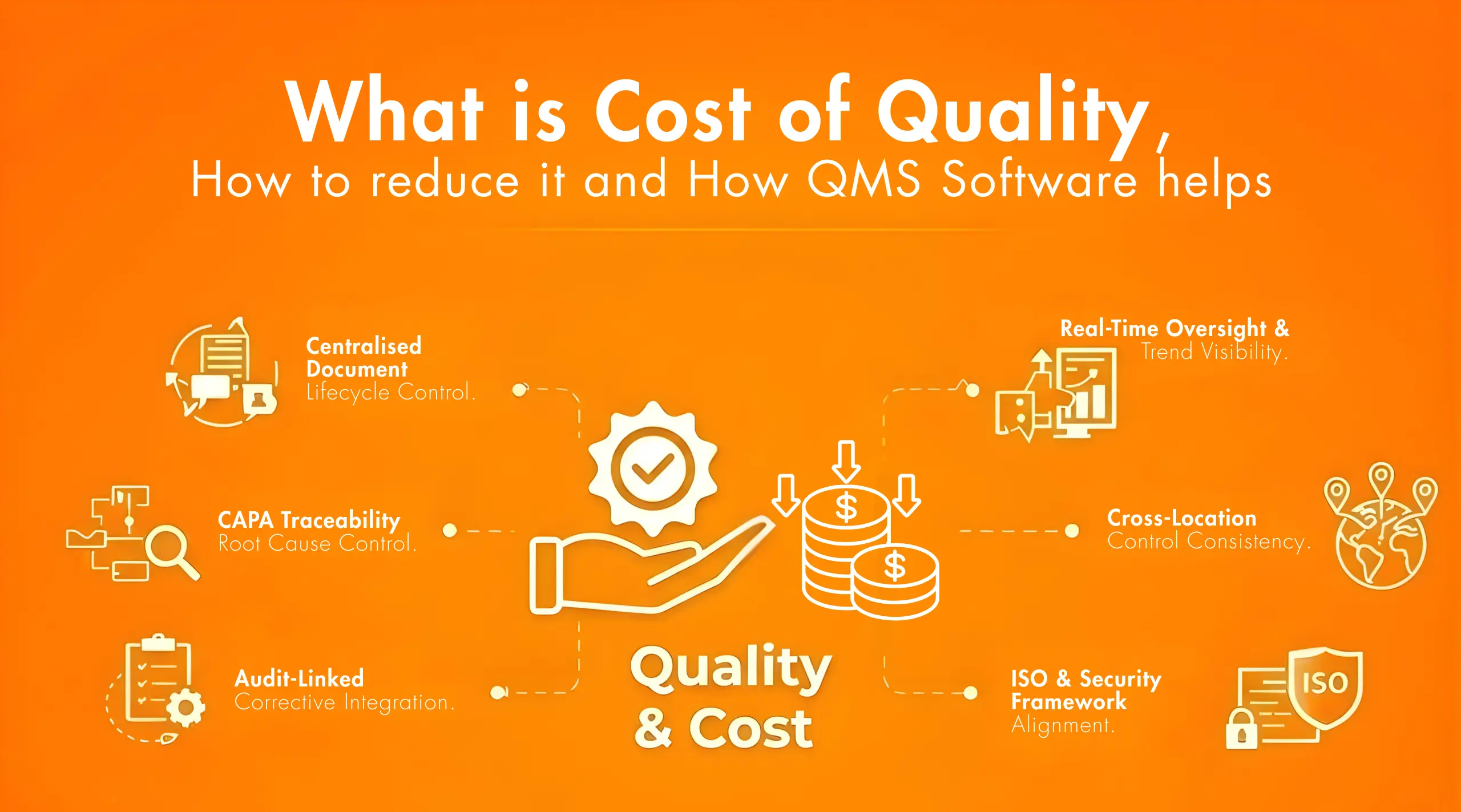
Reducing cost of quality at scale requires consistent control across documentation, nonconformity handling, audit management and performance monitoring. When these mechanisms operate in disconnected systems or manual environments, visibility is limited and failure-related costs tend to recur. A structured QMS software environment supports cost reduction by consolidating control activities within a defined, traceable framework.
- Centralized Document Lifecycle Control
Uncontrolled or outdated documentation contributes directly to internal nonconformities and audit findings. QMS software enforces version control, structured approval workflows, defined access permissions and revision traceability within a single system. This reduces ambiguity in execution and limits deviation caused by inconsistent document practices. In ISO-aligned environments, controlled documentation strengthens audit readiness and reduces rework associated with procedural misalignment.
- CAPA Traceability and Root Cause Control
Recurring failures increase the cost of poor quality when corrective actions are informal or inconsistently tracked. QMS software links nonconformity records to structured CAPA workflows, enabling documented root cause analysis, defined corrective measures, assigned accountability, implementation tracking and effectiveness verification. This structured traceability reduces recurrence and strengthens objective evidence during audits and certification reviews.
- Audit-Linked Corrective Integration
Audit findings that remain separate from operational control often reappear in subsequent assessments. QMS software connects audit observations directly to corrective and preventive action processes, ensuring follow-up activities are documented, assigned and verified within the same system environment. Integrated audit management reduces repeated observations and improves stability across surveillance and certification cycles.
- Real-Time Oversight and Trend Visibility
Failure costs frequently persist because management lacks consolidated visibility across nonconformities, corrective actions, audit results and performance indicators. QMS software centralizes these data streams, allowing structured monitoring of trends across departments or locations. Trend visibility supports risk-based decision-making and reduces reliance on reactive intervention.
- Cross-Location Control Consistency
In multi-site or distributed environments, variation in execution increases nonconformity exposure. QMS software standardizes documentation control, audit handling and corrective workflows under a unified framework. Consistent system execution across locations reduces variability-driven failures and supports stable ISO compliance.
- Support for ISO and Security Framework Alignment
For organizations operating under ISO 9001, ISO 27001, or related management standards, QMS software provides structured control over documented information, internal audits, corrective action records and management review inputs. In SaaS environments preparing for SOC 2 or ISO 27001 certification, systemised evidence management reduces manual preparation effort and audit exposure.
By strengthening preventive control, verification discipline and corrective traceability within a single framework, QMS software supports sustained reduction in failure-driven costs.
How Pyraman Helps Reduce Cost of Quality
Pyraman supports reduction in cost of quality by consolidating documentation control, audit management, nonconformity handling and corrective action tracking within a structured QMS environment. Instead of operating through disconnected tools or manual coordination, organizations manage prevention, appraisal and failure control within a single controlled framework.
By standardizing how documented information, audit findings and corrective actions are captured and tracked, Pyraman reduces fragmentation and improves traceability. Nonconformities are linked directly to structured CAPA processes, strengthening root cause control and reducing recurrence. Consolidated oversight improves visibility into quality performance across functions or locations.
As compliance scope expands or organizational complexity increases, Pyraman maintains consistency in execution without increasing administrative burden. This supports stable ISO alignment, improved cost visibility and sustained control over failure-driven quality expenditure.
Frequently Asked Questions (FAQ)
-
What is cost of quality?
Cost of quality represents the total financial impact of managing quality within an organization. It includes both preventive efforts embedded in the management system and failure-driven costs arising from nonconformities. Rather than being only a financial measure, it reflects how structured, traceable and controlled operational processes are. When tracked systematically, it provides visibility into system performance and compliance stability.
-
What is cost of poor quality?
Cost of poor quality refers to the total expense caused by internal and external failures. Internal failures occur before delivery and include rework, corrective actions and repeated verification. External failures occur after delivery and may involve complaints, penalties or certification exposure. Elevated cost of poor quality often indicates gaps in preventive structure or ineffective corrective traceability.
-
What are the four types of quality cost?
The four types of quality cost are:
- Prevention costs.
- Appraisal costs.
- Internal failure costs.
- External failure costs.
Prevention and appraisal represent structured conformance activities, while internal and external failures represent breakdowns in system execution.
-
What is the cost of poor quality formula?
The cost of poor quality formula is:
Cost of Poor Quality (CoPQ) = Internal Failure Costs + External Failure Costs
This formula aggregates all failure-driven expenditure for a defined reporting period and supports structured financial visibility within the management system.
-
How to calculate cost of poor quality?
To calculate cost of poor quality, organisations:
- Identify internal failure expenses
- Identify external failure expenses
- Consolidate both categories within a defined timeframe
Systemized documentation and traceability improve accuracy and reduce estimation errors.
-
What are the types of quality cost?
The types of quality cost include prevention, appraisal, internal failure and external failure costs. This classification supports structured analysis of where resources are invested and where failures generate operational impact. Within ISO-aligned systems, these categories enable clearer linkage between process control and financial exposure.
-
What is the best way for a company to reduce the cost of quality and improve customer satisfaction?
The most effective approach is structural improvement rather than isolated correction. This includes:
- Standardised and documented processes.
- Controlled document governance.
- Structured CAPA mechanisms.
- Integrated audit follow-up.
- Consolidated performance monitoring.
When preventive controls strengthen, failure-driven costs decline and customer confidence stabilizes.

Start Your Free 30-Day eQMS Trial
Get full access to Pyraman eQMS for 30 days, free. No commitment, just hands-on document control, audits, and compliance management.
