
How Food Industry Companies Can Simplify Compliance Using eQMS
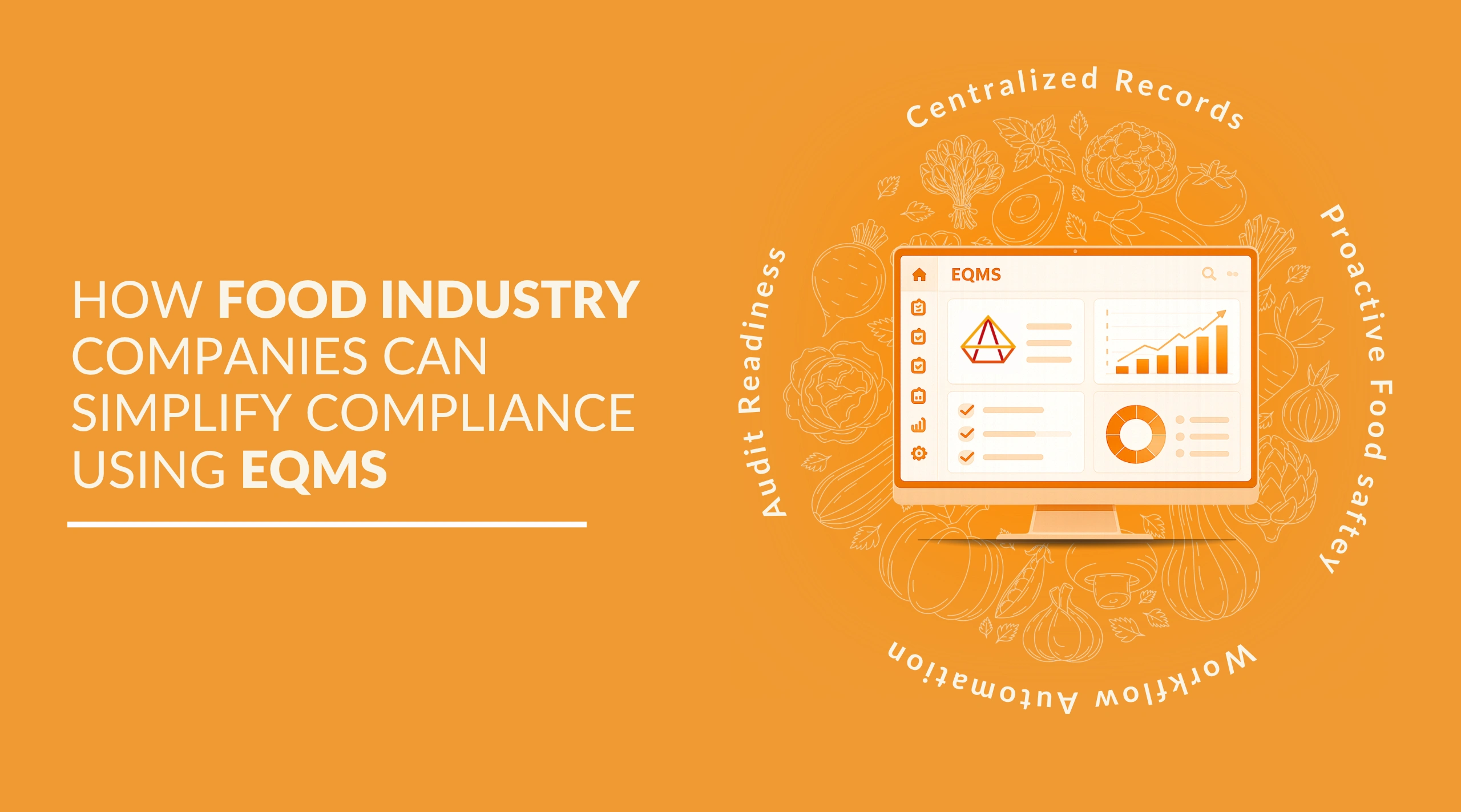
Walk into any food manufacturing facility, and you will see food safety compliance everywhere: temperature logs, batch records, supplier approvals, audit trails, HACCP plans, training records, and corrective actions. Every one of them matters. Every one of them is audited. And even a small gap can put certifications, market access, and brand reputation at risk.
Over time, this responsibility has only grown heavier. Regulatory expectations have tightened, global supply chains have grown more complex, and standards such as the BRCGS Food Safety Standard, ISO 22000, and FSSC 22000 now demand greater control, traceability, and accountability across every process.
For many food businesses, the real challenge is not understanding compliance; it is managing it efficiently without overwhelming teams with paperwork, spreadsheets, and manual tracking.
This is where an eQMS (electronic Quality Management System) changes the game as a powerful food safety software, transforming scattered, manual processes into a centralized, streamlined system that keeps operations controlled, connected, and always audit-ready.
The Growing Complexity of Food Safety Compliance
Managing food safety compliance today is no longer limited to meeting basic regulatory requirements; it involves handling multiple interconnected factors within an effective Food Safety Management System.
Key drivers of this complexity include:
- Global supply chains: Multi-country sourcing increases the burden of managing supplier certifications, documentation, and traceability.
- Multiple certification standards: Frameworks like ISO 22000, FSSC 22000, and BRCGS operate in parallel, creating overlapping requirements and increased workload.
- Regulatory pressure: Authorities such as the Food Safety and Standards Authority of India, along with regulations like the Food Safety Modernization Act, demand continuous monitoring and preventive, evidence-based compliance.
- Traceability expectations: Businesses must instantly track products across the supply chain to prevent and respond to risks effectively.
- Workforce and training gaps: Frequent workforce changes make it difficult to maintain up-to-date training, competency, and audit readiness.
The increasing complexity of food safety compliance directly leads to practical challenges that companies must manage every day.
Key Compliance Challenges Faced by Food Industry Companies
Before solving food safety compliance, it is important to define where it breaks down. Across food processors, manufacturers, packers, and cold chain operators, the same gaps appear again and again, not due to lack of intent but due to lack of structure.
-
Document chaos
Food safety documentation SOPs, HACCP plans, policies, and supplier records must be controlled, approved, and instantly accessible. In manual environments, documents are scattered, versions are unclear, and approvals move through emails. The result is simple: teams work on outdated information, and audits turn into document searches instead of validations.
-
Disconnected records
Critical compliance data, CCP logs, monitoring records, non-conformance reports, CAPAs, and calibration records exist across spreadsheets, folders, and inboxes. This fragmentation makes it difficult to present a complete, traceable compliance story when it matters most.
-
Reactive non-conformance management
When deviations occur, the focus often stays on immediate fixes rather than root-cause resolution. Without a structured NC and CAPA system, the same issues repeat, leading to recurring audit findings and operational inefficiencies.
-
Audit unpreparedness
Audit readiness should be continuous. Yet, in many organizations, it becomes a last-minute effort. Weeks are spent compiling records, verifying data, and closing gaps, increasing pressure on teams and risk during inspections.
-
Inadequate training tracking
Compliance depends on people as much as processes. Without a system to track training, competencies, and refreshers, gaps remain invisible until they surface as non-conformities.
-
Risk management blind spots
Hazard analysis and risk assessment are often treated as static activities. Without continuous monitoring and updates, businesses struggle to respond to changing risks across suppliers, processes, and products.
-
Escalating audit costs
A significant portion of audit effort is spent on coordination, documentation, and follow-ups. Without a structured audit management approach, resources are consumed by administration instead of driving actual quality improvement.
These are not isolated issues; they are systemic gaps created by fragmented systems and manual processes. And solving them requires more than incremental fixes. It requires a connected, digital approach to compliance.
How eQMS Simplifies Food Safety Compliance
An electronic Quality Management System (eQMS) does more than digitise existing processes; it acts as an advanced food management system that restructures how compliance is managed. Instead of operating through disconnected tools and reactive workflows, food safety activities are brought into a single, integrated system where every action is controlled, traceable, and continuously aligned with standards such as the BRCGS Food Safety Standard and ISO 22000.
What changes is not just where data lives but how compliance operates, shifting from fragmented execution to structured, system-driven control.
-
Centralised Document Control
All critical documents, SOPs, HACCP plans, policies, and work instructions are maintained within a single, controlled repository. Version control, approval workflows, and access permissions are embedded into the system, ensuring that only current, approved documents are in use.
When updates are required, the system automatically routes documents for review and approval, maintains revision history, and preserves a complete audit trail. This eliminates version confusion and ensures consistency across operations.
-
Structured Record Management
An EQMS standardises how records are captured, stored, and retrieved. Whether it is CCP monitoring logs, supplier evaluations, or quality checks, every record is linked to the relevant process, product, or batch.
This structure ensures data integrity and instant accessibility. During audits, records can be retrieved in seconds, with complete traceability and chronological history, removing the delays and risks associated with manual record-keeping.
-
Systematic NC and CAPA Management
Non-conformances are managed through a defined, end-to-end workflow. Each deviation is logged, assigned, investigated for root cause, and resolved through corrective and preventive actions (CAPA).
This approach transforms issue handling from reactive firefighting into a structured improvement mechanism, reducing repeat deviations and strengthening overall process control.
-
Proactive Audit Management
Internal audits are planned, executed, and closed within the system using standardised checklists and workflows. Findings are tracked to resolution, and audit data feeds directly into management reviews and improvement initiatives.
When external audits occur, whether for the BRCGS Food Safety Standard or ISO 22000, the organisation operates from a state of continuous readiness with all evidence structured and readily available.
-
Automated Training and Competency Tracking
An eQMS ensures that workforce competency is continuously monitored. Employee training records, certifications, and assessments are tracked centrally, with automated alerts for renewals and pending training.
This provides clear visibility into workforce readiness and ensures that compliance is supported by qualified, up-to-date personnel, a critical requirement in food safety systems.
-
Real-Time Risk Visibility
Integrated risk management tools, including HACCP modules, enable teams to identify, assess, and control hazards dynamically. Risk data is continuously updated as processes evolve, suppliers change, or new products are introduced.
This ensures that hazard analysis remains a living process, allowing organisations to respond proactively rather than reactively to emerging risks.
-
Complaint Management and Feedback Loops
Customer complaints and feedback are captured within structured workflows and linked to specific batches, products, or processes. Investigations are triggered automatically, and resolutions are tracked to closure.
Over time, this data becomes a valuable insight engine, helping organisations identify patterns, prevent recurring issues, and drive continuous improvement. With an eQMS, compliance is no longer dependent on manual coordination or individual effort. It becomes a system-driven function: consistent, transparent, and always audit-ready.
Role of eQMS in Meeting Food Safety and Regulatory Requirements
Food companies must comply with multiple standards such as ISO 22000, FSSC 22000, and GMP, all of which require strong documentation, process control, and audit readiness.
An eQMS helps manage these requirements by standardising processes, maintaining records, and ensuring traceability across the food safety system.
- Hazard Analysis and HACCP: Food safety standards universally require a scientifically validated Hazard Analysis and Critical Control Points plan as a core part of HACCP compliance that is continuously updated based on process, product, or ingredient changes. An eQMS ensures HACCP plans remain dynamic, version-controlled, and directly linked to monitoring records, making them audit-ready at all times.
- Management Responsibility and Commitment: Regulatory frameworks expect active involvement from senior management through defined objectives, periodic reviews, and documented decisions. An eQMS captures this through structured workflows, objective tracking, and meeting records, creating clear evidence of leadership accountability.
- Food Safety Culture: Modern food safety standards increasingly emphasise culture, ensuring that food safety is embedded into daily operations. Through training management, communication logs, and performance tracking, an eQMS provides measurable evidence that employees are engaged and aligned with food safety goals.
- Supplier and Vendor Management: Compliance frameworks require robust supplier approval and monitoring systems, including risk assessments, audits, and performance tracking. An eQMS centralises supplier data, ensuring all documentation is organised, updated, and easily accessible during inspections.
- Internal Audits: Regular internal audits are mandatory across most standards to verify system effectiveness. An eQMS enables organisations to plan, execute, and track audits systematically, linking findings directly to corrective actions and maintaining a complete audit trail.
- Non-Conformances and Corrective Actions (CAPA): All food safety standards require structured handling of deviations, including root cause analysis and corrective action verification. An eQMS enforces this process through automated workflows, ensuring accountability and preventing recurring issues.
An eQMS brings all food safety compliance activities into a single system, making it easier to manage audits, maintain consistency, and demonstrate control across multiple standards in a food safety management system. It’s built-in audit trail ensures every action is recorded and traceable, supporting both compliance and continuous improvement.
How Pyraman eQMS Transforms Food Safety Compliance
Ready to simplify your food safety compliance journey? With Pyraman eQMS, you can move beyond fragmented systems and manual processes to a fully connected, audit-ready quality ecosystem. From HACCP and document control to audits, training, and corrective actions, every aspect of your compliance is streamlined within one intelligent platform, helping you reduce risk and improve efficiency and stay aligned with standards like BRCGS Food Safety and ISO frameworks.
Take the next step towards smarter compliance with Pyraman. Empower your team with real-time visibility, automated workflows, and a scalable food safety compliance system designed for the modern food industry. Book a free demo today and discover how Pyraman can transform your quality management approach into a proactive, efficient, and future-ready system.
FAQs:
-
How does eQMS support HACCP implementation?
An eQMS helps manage Hazard Analysis and Critical Control Points by maintaining updated plans, linking monitoring records, and ensuring all critical control points are tracked and documented effectively.
-
Can eQMS help with ISO 22000 and FSSC 22000 certification?
Yes, an eQMS supports compliance with standards like ISO 22000 and FSSC 22000 by managing documentation, audits, risk assessments, and corrective actions in line with their requirements.
-
Can eQMS reduce audit failures?
Yes, by ensuring proper documentation, real-time updates, and structured workflows, an eQMS minimizes gaps that often lead to audit non-conformities.
-
Does eQMS help in managing food recalls?
Yes, with strong traceability and record management, an eQMS enables faster identification of affected batches and supports efficient recall management.
-
How does eQMS improve operational efficiency in food companies?
By automating workflows and reducing manual tasks, an eQMS saves time, improves accuracy, and allows teams to focus on quality and improvement.

Start Your Free 30-Day eQMS Trial
Get full access to Pyraman eQMS for 30 days, free. No commitment, just hands-on document control, audits, and compliance management.
