
How QMS Software Strengthens Data Security While Preserving Data Confidentiality
Quality systems now operate in environments where operational records exist almost entirely in digital form. Audit evidence, corrective actions, supplier assessments and performance data are no longer confined to controlled binders. They reside inside software platforms that support daily quality activity. That shift improves efficiency, but it also changes the risk profile.
When quality data becomes centralised and continuously accessed, exposure risks increase. Regulatory disciplines have tightened and organisations are expected to demonstrate not only compliance but control. Data security therefore becomes inseparable from quality governance.
A structured QMS platform must do more than automate workflows. It must preserve data confidentiality, restrict access appropriately and maintain integrity of approved records over time. Without integrated controls digitalization simply moves risk from paper to software.
What Is Data Security
Data security is as a structured protection of digital information from unauthorised access, alteration, loss or misuse. In a Quality Management System includes safeguarding documents, audit records, corrective action, supplier data, customer complaints and internal performance. Data security ensures that only authorised personnel can view, edit or approve records. It prevents deletion, unauthorised modification and any possible breaches. Uncontrolled data leads to manipulation, inconsistency or unauthorized exposure. Within a QMS environment confidential data ranging from proprietary processes and product specifications to audit findings and customer information which must be protected. Safeguarding this data is more than a technical necessity, it is a core governance responsibility.
Common Data Security Risks in Manual Quality Systems
- Spreadsheets
Spreadsheets used for tracking audits, CAPA, deviations or KPIs operate without enforced access controls or structured revision history. Files can be copied, renamed or edited without traceability. As data volume increases, tracking ownership and authenticity becomes difficult. This weakens data integrity and creates uncertainty during audits.
- Email Approvals
Email-based approvals fragment documentation trails. Attachments circulate independently, often resulting in multiple versions of the same file. There is no centralised log that confirms which version was formally approved. Over time, this creates inconsistency between operational execution and documented records.
- Local Drives
Quality documents stored on shared drives depend heavily on folder discipline rather than structured governance. Broad access permissions may allow unintended edits or deletions. Backup practices vary, and recovery from accidental loss can be unreliable. Local storage environments rarely provide continuous monitoring or audit traceability.
- Uncontrolled Access
Without defined role-based restrictions, sensitive records may be accessible beyond operational necessity. Supplier evaluations, audit findings or proprietary procedures can be viewed or altered without structured oversight. This increases exposure risk and weakens internal data confidentiality.
- Version Confusion
In manual systems, multiple copies of procedures often coexist across departments. Employees may unknowingly refer to outdated instructions. Without embedded version control, there is no system-driven assurance that only current approved documents are active. This directly affects compliance consistency and operational reliability.
Why Data Security Matters in Modern QMS Software
Data security in a QMS environment affects operational reliability, compliance credibility and long-term organisational trust. It is not limited to preventing external breaches; it determines whether internal records remain controlled, traceable and defensible under inspection.
- Regulatory Pressure: Regulatory frameworks expect documented evidence to remain protected from unauthorised alteration. Standards such as ISO-based systems require controlled documentation, defined approval mechanisms and preservation of record history. If digital quality data can be modified without restriction, the organisation cannot demonstrate procedural discipline. Regulators increasingly assess not just documentation presence, but documentation control. Structured data security mechanisms provide verifiable proof that information remains protected and historically consistent.
- Audit Requirements: During internal and external audits, credibility depends on whether records can be trusted. Auditors evaluate revision control, approval timestamps, user access history and change logs. If documentation lacks traceability or if system permissions are loosely defined, audit confidence weakens. Secure QMS platforms preserve historical integrity, making it possible to demonstrate that records reflect actual operational activity rather than reconstructed evidence.
- Intellectual Property Protection: Quality systems often contain process parameters, validation data, supplier qualification records and proprietary manufacturing controls. This information represents operational expertise developed over time. Unauthorised exposure can compromise competitive advantage and contractual confidentiality. A structured QMS environment ensures that sensitive process knowledge remains accessible only to authorised roles while preserving operational transparency internally.
- Supplier and Customer Trust: Modern supply chains rely on controlled data exchange. Customers may review audit findings, corrective actions or product validation records. Suppliers share compliance documentation and performance data. Organisations must demonstrate responsible handling of shared information. Strong data confidentiality practices signal reliability and reinforce professional accountability in business relationships.
- Risk Mitigation: Data breaches, accidental deletions or untracked modifications introduce operational instability. Incorrect or outdated records can influence decision-making, delay corrective actions or compromise product quality. Secure QMS systems reduce this exposure by embedding access control, change tracking and recovery mechanisms within daily workflows. Effective risk mitigation strengthens both operational continuity and compliance resilience.
How QMS Software Strengthens Data Security
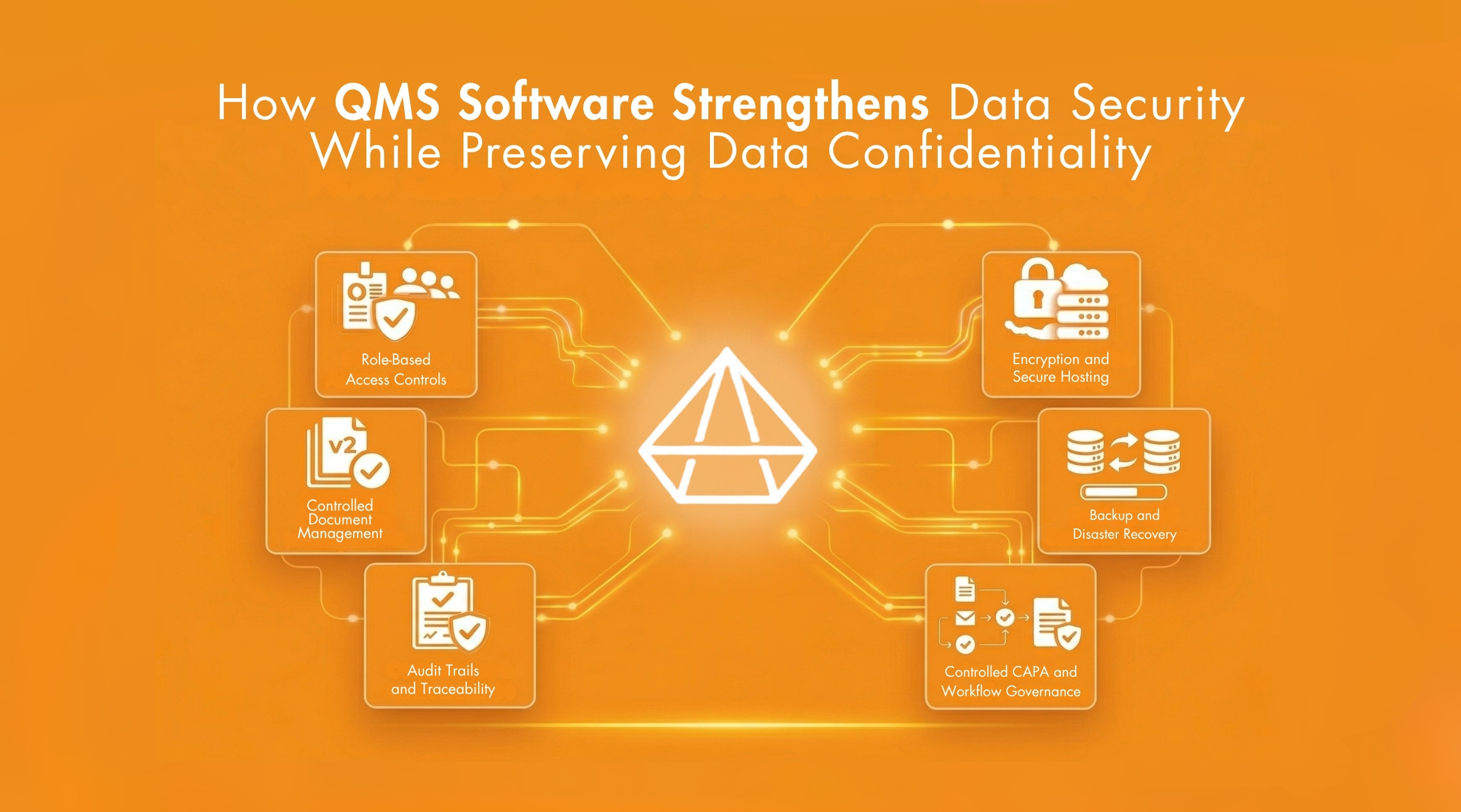
Modern QMS software does not treat security as an external IT layer. Protection is embedded into system architecture and enforced through defined workflows, access hierarchies and traceable actions. Instead of relying on manual discipline, the platform itself governs how data is accessed, modified and preserved.
-
Role-Based Access Controls:
Every user operates within predefined permission boundaries. Access is granted based on functional responsibility rather than general system visibility. Production teams may update inspection data, quality managers may approve corrective actions, while auditors may have read-only access. This structure prevents unnecessary exposure of sensitive records and limits the risk of unauthorised modification. By defining access at the role level, the system reduces internal vulnerabilities while preserving operational clarity.
-
Encryption and Secure Hosting:
Data stored within QMS platforms is protected through encrypted transmission and storage protocols. Encryption ensures that information cannot be interpreted if intercepted during transfer. Secure hosting environments further isolate system infrastructure from unauthorised external access. These technical safeguards operate continuously in the background, protecting records without interrupting operational workflows.
-
Audit Trails and Traceability:
Every interaction within the system generates a traceable record. Document revisions, status changes, approvals and corrective actions are time-stamped and linked to specific users. This creates a permanent activity history that cannot be overwritten or deleted casually. Traceability discourages informal changes and strengthens accountability, ensuring that data history reflects actual system use.
-
Controlled Document Management:
Document control modules enforce structured version management. When a procedure is revised, previous versions are archived automatically while only the approved version remains active. Users cannot modify documents outside defined workflows. This eliminates parallel document copies and prevents outdated instructions from circulating within operations.
-
Backup and Disaster Recovery:
QMS platforms incorporate automated backup routines to preserve records in the event of system failure or technical disruption. Recovery protocols allow organisations to restore complete datasets without compromising record integrity. Redundancy mechanisms ensure that quality data remains available and intact even during unexpected incidents.
-
Controlled CAPA and Workflow Governance:
Corrective actions, deviations and approval processes follow structured digital paths. Informal email approvals or undocumented changes are eliminated because every stage requires system-based validation. Each workflow step is recorded, permission-controlled and historically preserved. This embedded governance reduces the risk of unnoticed alterations and ensures measurable oversight of quality events.
Preserving Data Integrity and Confidentiality Together
Data integrity concerns the reliability and consistency of information over time. Within a QMS environment, it ensures that once a document, audit record or corrective action is approved, its content cannot be altered without a controlled revision process. Integrity protects the substance of the data.
Confidentiality, on the other hand, governs access. It determines who is permitted to view, edit or approve specific records. While security mechanisms may prevent external intrusion, confidentiality defines internal boundaries of access.
Version control mechanisms preserve integrity by archiving historical revisions and restricting uncontrolled duplication. Each modification follows a documented revision path, maintaining traceability across system history. Approval workflows introduce structured validation before updates become active, preventing informal edits or bypassed reviews.
When integrity and confidentiality operate together, the system protects both the content and the access pathway. Records remain accurate, access remains controlled and the quality system retains operational credibility.
How Pyraman Protects Data Security and Confidentiality
Data security and confidentiality controls are only effective when they are consistently enforced within operational workflows. Pyraman supports organisations by embedding structured protection mechanisms directly into its EQMS software architecture. Rather than treating security as a separate layer, the platform integrates controlled access, traceability and governance within everyday quality activities.
Pyraman replaces fragmented storage environments with a centralised and secure system where quality records are managed within defined boundaries. Documents, audit findings, CAPA records and performance data are stored within a unified environment that applies consistent access rules across teams and functions. This reduces exposure caused by scattered files, uncontrolled sharing or informal handling of sensitive information.
By enforcing role-based permissions, approval logic and traceable system activity, Pyraman ensures that quality data remains accessible only to authorised users. Every modification, approval and workflow transition is recorded within structured audit logs, preserving both data integrity and confidentiality. These controls are embedded into the system rather than dependent on individual discipline.
Pyraman further strengthens governance by maintaining clear visibility into document status, revision history and user activity. Historical records are preserved securely, while outdated or unauthorised versions are restricted from operational use. This allows organisations to demonstrate controlled data management during audits, management reviews and compliance assessments without relying on manual oversight. If you’re looking to strengthen your quality data governance and bring greater control to your documentation processes, you can contact us to learn how Pyraman can be tailored to your organisation’s needs.
FAQ’s
-
What is data security in QMS?
Data security in a Quality Management System refers to the structured protection of quality records from unauthorised access, alteration or loss. It ensures that documents, audit logs, corrective actions and performance data remain controlled within defined system permissions. Effective data security safeguards both operational information and compliance evidence throughout the record lifecycle.
-
How does QMS software protect confidential data?
QMS software protects confidential data through role-based access controls, encrypted storage and traceable approval workflows. Users are granted permissions based on their responsibilities, limiting unnecessary exposure. System logs record every modification and approval, ensuring that sensitive information remains both restricted and accountable.
-
What is the confidential data meaning in a QMS context?
The confidential data meaning within a QMS environment refers to sensitive operational records such as proprietary processes, product specifications, audit findings, supplier evaluations and customer-related information. These records must be restricted to authorised roles to preserve compliance and competitive integrity.
-
Why are data integrity and confidentiality important together?
Data integrity and confidentiality work together to maintain both the accuracy and restricted access of quality records. Integrity ensures that information remains complete and unchanged unless formally revised, while confidentiality ensures that only authorised individuals can access that information. Together, they protect compliance credibility and operational trust.
-
What is the difference between data security and data confidentiality?
Data security focuses on protecting information from external threats, unauthorised access or technical breaches. Data confidentiality specifically controls who within the organisation is permitted to view or use sensitive information. While security protects the system environment, confidentiality manages access boundaries within that environment.

More than Thoughts.
More than a Free Trial.
Register yourselves for a digital experience that makes operational excellence attainable.
