
Warning Signs That Your NC Management Process Needs Digitalization
Managing non-conformances (NCs) is a fundamental requirement of any quality, compliance, or management system. NCs originate from audits, inspections, customer complaints, regulatory findings, and internal process deviations. Their role goes far beyond documentation. Effective NC management ensures issues are properly analysed, corrective actions are implemented, effectiveness is verified, and recurrence is prevented.
Despite this importance, many organisations continue to manage NCs using spreadsheets, emails, shared folders, and manual follow-ups. While these methods may appear workable at a small scale, they become increasingly fragile as organisations grow. As NC volumes rise, audits become more frequent, and multiple teams get involved, weaknesses begin to surface.
These weaknesses rarely appear overnight. They develop gradually and often go unnoticed until NC management itself starts creating operational risk missed actions, audit pressure, or loss of control rather than supporting quality assurance. At this stage, incremental improvements no longer resolve the problem. Digitalization becomes necessary when NC identification, corrective action tracking, and closure are constrained by fragmented information, manual coordination, and inconsistent process enforcement.
Key Warning Signs That Manual NC Management Is No Longer Sustainable
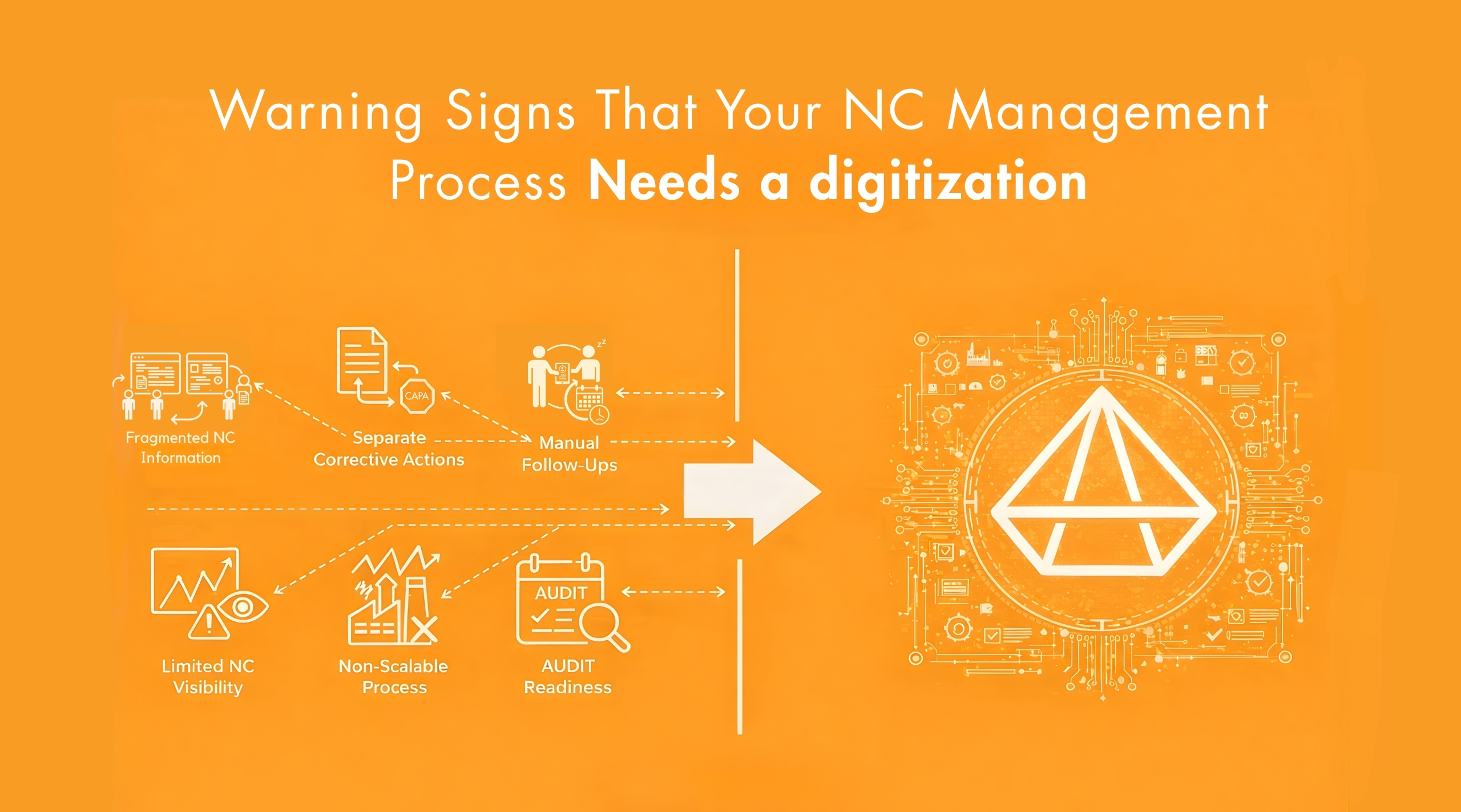
As organisations mature, NC management complexity increases in ways that are not always immediately visible. The following warning signs indicate that existing NC practices are no longer structurally equipped to support consistency, traceability, and compliance expectations. When several of these signs appear together, they signal a clear need for digital NC management rather than temporary workarounds.
NC Information Is Fragmented Across Tools and Teams
In manual environments, NC records, root cause analyses, corrective actions, and supporting evidence are often scattered across spreadsheets, email threads, shared drives, and local folders. Different teams use different formats and tracking methods, making consolidation time-consuming and error-prone.
Over time, this fragmentation weakens traceability and makes it difficult to establish a complete and reliable NC history. Quality teams spend excessive time searching records and data instead of analysing outcomes. As a result, confidence in NC completeness declines, and management visibility into overall quality performance becomes limited.
Corrective Actions Are Managed Separately from NCs
When NCs and corrective actions are tracked through separate systems or informal methods, accountability becomes inconsistent. Ownership, timelines, closure status, and effectiveness checks vary across teams and locations. In some cases, corrective actions are marked complete without systematic verification or without being clearly linked to the originating NC.
This separation increases the likelihood of recurring issues. Lessons learned remain localised, organisational learning is limited, and improvement efforts remain reactive rather than structured and preventive.
NC Closure Depends on Manual Follow-Ups
In manual NC management processes, closure often relies on reminders, escalations, and individual diligence. Open NCs may remain unnoticed until management reviews or external audits highlight overdue actions. Status tracking is typically periodic rather than continuous.
This approach increases the risk of missed commitments and incomplete corrective actions. Over time, NC management becomes dependent on people remembering to follow up instead of being governed by controlled processes, increasing variability and risk.
NC Readiness Is Verified Only During Audits
When NC records and supporting evidence are not maintained as part of routine operations, verification is often postponed until audits or assessments are scheduled. Teams then rush to reconstruct NC histories, gather documents, and explain timelines under pressure.
This last-minute effort disrupts daily operations and creates uneven preparedness across teams. NC management becomes audit-driven and reactive rather than controlled, continuous, and predictable.
Limited Visibility into NC Trends and Recurrence
Manual NC tracking typically treats each NC as an isolated event. Identifying recurring issues, high-risk processes, or ineffective corrective actions requires manual analysis and subjective interpretation. Trend visibility remains limited, and preventive actions are difficult to justify with confidence.
Without structured data, management oversight remains reactive. Systemic issues may persist for extended periods before being recognised, increasing exposure to quality failures and compliance risk.
NC Processes Do Not Scale with Organisational Growth
As NC volumes increase across audits, departments, locations, and regulatory requirements, manual tracking effort grows faster than control. Additional spreadsheets, reports, and coordination layers are added in an attempt to manage complexity.
Instead of improving reliability, this approach increases administrative burden and process fragility. When organisational growth adds complexity without strengthening control, it is a clear indication that manual NC management is no longer sustainable.
How Digital NC Management Addresses These Challenges
Digital NC management provides a structured foundation for handling non-conformances by integrating identification, analysis, corrective actions, verification, and closure into a single operational framework. Rather than managing NCs as disconnected records maintained by individuals or teams, organisations gain consistency, visibility, and control across the entire NC lifecycle.
By embedding NC management into defined system workflows, digitalization shifts control from manual coordination to process governance. NC management functions as a reliable quality mechanism rather than an administrative obligation that consumes disproportionate effort.
Centralised NC Records with Controlled Access
In a digital NC management environment, all NC records, supporting evidence, corrective actions, and verification data are maintained within a single structured system. This eliminates fragmentation and reduces the need for manual data consolidation across teams or departments.
Controlled access ensures users interact only with relevant and approved information based on defined roles and responsibilities. Updates, revisions, and status changes are recorded systematically, preserving a complete and traceable NC history throughout its lifecycle.
Standardised NC Handling Across the Organisation
Digital NC management enforces a consistent approach to how non-conformances are logged, analysed, corrected, and closed across the organisation. While NCs may originate from different functions or processes, the handling framework remains uniform.
This standardisation reduces variation in corrective action quality and limits dependence on individual interpretation or local practices. Over time, it strengthens process control and ensures NC outcomes are repeatable, comparable, and aligned with defined quality expectations.
Direct Linkage Between NCs, Root Causes, and Actions
A digital NC management system establishes clear, traceable links between each NC, its identified root cause, associated corrective actions, and effectiveness verification. Ownership, timelines, and closure criteria are managed within a single framework rather than across disconnected tools.
This linkage ensures corrective actions cannot be treated as isolated tasks. Effectiveness is verified before closure, outcomes are retained for future reference, and recurrence risk is reduced through structured organisational learning.
Continuous NC Readiness Instead of Reactive Verification
Digitalization enables NC records and supporting evidence to be maintained as part of routine operations rather than assembled only when audits are scheduled. Status, documentation, and verification information remain current and accessible at all times.
As a result, audit readiness becomes continuous rather than event-driven. Teams operate with greater confidence, and audits no longer disrupt normal operations through last-minute preparation.
Reduced Administrative Burden on Quality Teams
In manual environments, skilled quality personnel spend disproportionate time maintaining records, chasing updates, and searching information across tools. This administrative load reduces the time available for root cause analysis, preventive planning, and process improvement.
Digital NC management reduces this burden by integrating tracking, visibility and documentation into system workflows. Over time, this improves engagement, strengthens the effectiveness of the quality function, and shifts focus from coordination to improvement.
How Pyraman Supports Digital NC Management
Pyraman supports digital NC management by bringing non-conformance identification, corrective actions, verification, and records into a single structured system. Instead of relying on spreadsheets, emails, or isolated trackers, organisations operate within a consistent NC framework across teams and audits. Through this structured approach, Pyraman enables organisations to:
- Capture and categorise non-conformances in a centralised system
- Assign clear ownership with defined timelines
- Link corrective actions directly to originating NCs
- Maintain documented root cause analysis within the workflow
- Preserve supporting evidence and verification records
NCs are governed through defined workflows that apply approval controls, effectiveness checks, and structured closure validation. As volumes increase, the system scales through process discipline rather than manual coordination. Operationally, this ensures:
- Real-time visibility of open and closed NCs
- Controlled verification before formal closure
- Reduced dependency on follow-up emails
- Improved audit traceability
- Sustainable NC governance as the organisation grows
By integrating NC management into routine operations, Pyraman supports continuous audit readiness and controlled quality oversight. Want to strengthen your digital NC management process? Contact us to learn how Pyraman can help structure and scale your non-conformance control.
Frequently Asked Questions (FAQ)
-
What is non-conformance (NC) management in a quality system?
Non-conformance management is the structured process of identifying, analysing, correcting, verifying, and closing deviations from defined requirements, procedures, or standards. Its purpose is to prevent recurrence and support continuous improvement, not just document issues.
-
Why does manual NC management become unreliable as organisations grow?
Manual NC management relies heavily on individual effort, informal coordination, and fragmented records. As NC volumes increase across audits, teams, and processes, delays, missed actions, and traceability gaps emerge, reducing reliability and increasing operational risk.
-
What risks arise when NC records are spread across spreadsheets and emails?
Fragmented NC records make it difficult to maintain a complete and accurate NC history. Consolidation becomes time-consuming, errors increase, and visibility into status and trends weakens, creating challenges during audits and management reviews.
-
Why is linking corrective actions directly to NCs important?
Without direct linkage, corrective actions may be closed without verifying relevance or effectiveness. Linking actions to NCs ensures accountability, traceability, and confirmation that the underlying issue has been addressed.
-
How does digital NC management improve audit readiness?
Digital NC management maintains records, evidence, and status visibility as part of routine operations. This eliminates last-minute data collection and reconstruction, making audit readiness continuous rather than reactive.
-
Can digital NC management help reduce repeat non-conformances?
Yes. By enforcing structured root cause analysis, linking actions to causes, and requiring effectiveness verification before closure, digital NC management reduces recurrence and supports preventive control.
-
When should an organisation move to digital NC management?
Digitalization becomes necessary when NC tracking depends on manual follow-ups, records are fragmented, trend visibility is limited, or NC volume grows faster than control clear indicators that manual methods are no longer sustainable.
-
How does Pyraman fit into NC management digitalization?
Pyraman provides a governed NC management framework that replaces fragmented tracking with structured workflows, traceability, and continuous visibility, helping organisations maintain quality control and audit readiness as complexity grows.

More than a Free Trial.
Register yourselves for a digital experience that makes operational excellence attainable.
