
How Workflow Automation Improves Quality Management in the Pharmaceutical Industry
The pharmaceutical industry does not suffer from a lack of quality frameworks; it suffers from a lack of connected execution. Organizations invest heavily in SOPs, compliance systems and documentation, yet still face recurring audit findings and delayed resolutions. The reason is simple: when quality processes operate in isolation, efficiency declines and risk increases.
Workflow automation addresses this gap by transforming fragmented activities into a unified, continuously flowing system bringing structure, visibility and control into everyday quality operations. It reduces dependency on manual coordination, ensures accountability at every step and establishes a foundation for proactive rather than reactive quality management.
This is the core challenge that workflow automation solves and it is precisely what EQMS software is designed to address within the pharmaceutical industry.
The Hidden Problem: Quality Processes Are Not Truly Connected
In most mid-sized pharmaceutical organizations, a similar pattern can be observed. The quality team is diligent, experienced and committed to maintaining high standards. However, the tools they use often work against efficiency, especially when there is no integrated business management software environment to connect critical quality functions.
A deviation is recorded in one spreadsheet. The CAPA associated with it is tracked in another file. The document update initiated by that CAPA requires email approvals across multiple departments. The subsequent training update following the document revision is managed by HR in a completely separate system, rather than being aligned through a centralized QMS software for pharmaceutical industry.
Each step exists independently. However, there is no unified thread connecting them.
This level of fragmentation where each quality activity is technically completed but operationally disconnected leads to three consistent challenges within the pharmaceutical industry:
-
Visibility gaps:
No quality leader has a consolidated, real-time view of all active deviations, CAPAs, audits and complaints. Status updates require manual follow-ups and decisions are often based on outdated information.
-
Escalation failures:
When overdue actions are tracked only in spreadsheets, there is no automatic escalation. By the time delays are identified, valuable time has already been lost and in a regulated environment, such delays can have serious implications.
-
Audit unpreparedness:
When regulatory auditors request a complete lifecycle of a batch or non-conformance, teams struggle to compile data from multiple systems. Although the information exists, retrieving and aligning it requires significant effort and time.
The issue is not intent. It lies in the infrastructure.
How Workflow Automation Improves Quality Management in the Pharma Industry
In the pharmaceutical industry, quality is not just about maintaining records it is about ensuring that every activity moves in a controlled, connected and time-bound manner. However, when processes depend on emails, spreadsheets and manual follow-ups, execution slows down, visibility is lost and quality becomes reactive.
Workflow automation changes this by turning isolated quality activities into a structured, continuously moving system where actions are triggered automatically, decisions are recorded in real time and no step depends on manual coordination.
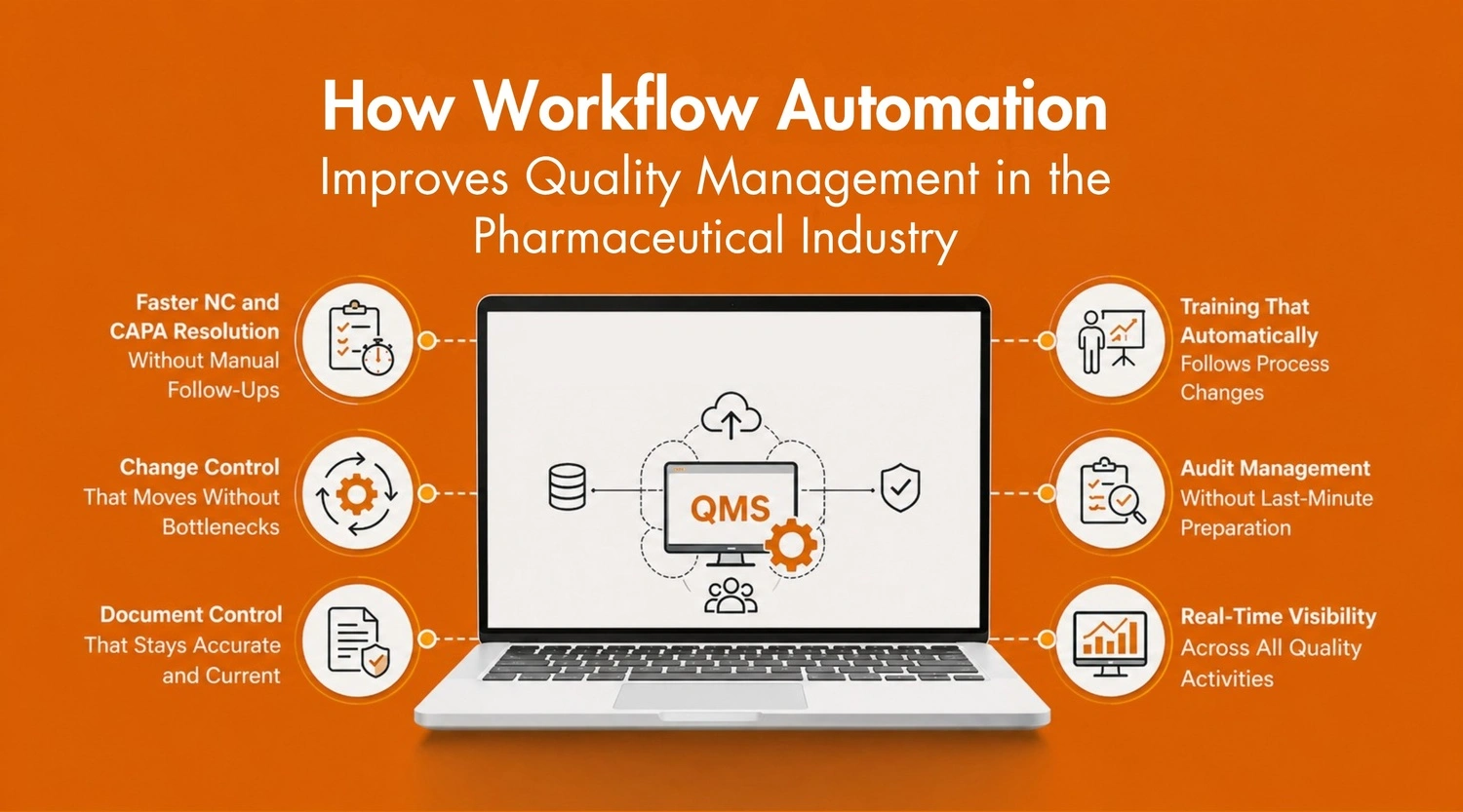
Faster NC and CAPA Resolution Without Manual Follow-Ups
NC Management and CAPA management are among the most resource-intensive quality activities in pharma.
With workflow automation:
- NCs are logged and instantly routed to the right team
- Investigation tasks are automatically assigned with defined timelines
- CAPAs are linked directly to root cause analysis
- Escalations are triggered before deadlines are missed
This ensures that issues move forward without delays, reducing aging CAPAs and improving overall closure efficiency.
Change Control That Moves Without Bottlenecks
Change control in pharma involves multiple stakeholders QA, regulatory, validation and production and often gets delayed due to dependency on manual approvals.
With automated workflows:
- Each approver is notified exactly when action is required
- Approvals follow a predefined sequence
- Decisions are recorded with timestamps and justification
- The change progresses automatically to the next stage
This removes bottlenecks and ensures that critical changes are implemented without unnecessary delays.
Document Control That Stays Accurate and Current
Managing documents manually often leads to version confusion and outdated usage.
With workflow-driven document control:
- Every document follows a structured lifecycle (draft → review → approval → release)
- Version control is maintained automatically
- Access to obsolete documents is restricted
- Distribution happens without manual intervention
This ensures that teams always work with the latest approved documents, reducing compliance risks.
Training That Automatically Follows Process Changes
A common gap in pharma quality systems is the disconnect between document updates and employee training.
Workflow automation bridges this by:
- Triggering training whenever a document or process is updated
- Assigning training to relevant users automatically
- Tracking completion within the same system
This ensures that process changes are not just documented, but actually implemented on the ground.
Audit Management Without Last-Minute Preparation
Audits often create pressure when records are scattered and updates are manual.
With workflow automation:
- Audit schedules are predefined and tracked
- Findings are recorded and linked to NC/CAPA workflows
- Corrective actions are monitored in real time
- Complete audit trails are available instantly
This makes audit readiness a continuous state rather than a last-minute effort.
Real-Time Visibility Across All Quality Activities
One of the biggest advantages of workflow automation is complete visibility.
When all quality processes are connected:
- Leaders can track every open NC, CAPA and audit finding
- Pending approvals and delays are visible instantly
- Training gaps and compliance risks are identified early
This shifts quality management from reactive firefighting to proactive control.
Role of QMS Software in Enabling Workflow Automation
To achieve this level of automation, pharmaceutical companies rely on advanced QMS software that integrates all quality processes within a single, unified platform. These systems connect a wide range of quality functions, ensuring seamless coordination and data flow across departments.
Key systems include:
- Document Management System
- Record Management System
- NC (Non-Conformance) Management System
- Audit Management System
- Complaint Management System
- Training Management System
Together, these systems form a connected quality ecosystem where processes no longer operate in isolation. This integration ensures greater consistency, end-to-end traceability, and enhanced control across the entire quality lifecycle.
Real Scenario: Before vs After Automation
In many pharmaceutical companies, quality processes exist, but their execution depends on how well they are managed on a daily basis.
| Before Workflow Automation | After Implementing Workflow Automation |
|---|---|
| CAPAs are delayed due to constant manual follow-ups | Processes are triggered automatically based on events (e.g., audit → NCR → CAPA) |
| Audit findings are recorded but not directly linked to corrective actions | Tasks are assigned to the right users without manual intervention |
| Teams rely on emails, spreadsheets, and multiple systems for tracking | Approvals and actions follow a predefined workflow |
| Status updates require manual checking and coordination | Real-time updates are available across all processes |
| Limited visibility into ongoing and pending quality activities | Complete visibility into status, delays, and closures |
| Higher chances of missed actions and repeated issues | All quality activities are connected within a single system |
This represents a practical transformation in how quality teams operate not a theoretical improvement, but a measurable change in efficiency and regulatory confidence.
How Pyraman EQMS Helps Pharma Companies Build a Connected Quality System
Pyraman enables pharma companies to operate within a fully connected, workflow-driven quality ecosystem where every process is seamlessly integrated. From deviations and CAPA to audits and documentation, all quality activities are aligned within a single system ensuring smooth coordination, structured execution, and consistent compliance across operations.
With automated workflows, tasks are triggered, assigned, and tracked without manual intervention, while approvals follow predefined pathways and every action remains fully traceable. Real-time visibility across processes keeps teams aligned, improves decision-making, and strengthens overall control of quality operations.
By bringing continuity across processes, data, and teams, Pyraman helps organizations build a more efficient, transparent, and audit-ready quality system making it easier to maintain compliance, improve performance, and confidently scale operations, so you can experience a smarter, connected quality system by booking a free demo today.
FAQs
-
Why is traceability important in pharmaceutical quality management?
Traceability is important because it allows organizations to track every action, decision and change within a process. In the pharma industry, this is critical for audits, investigations and compliance. A traceable system helps identify the root cause of issues, ensures accountability and provides clear evidence that processes have been followed correctly.
-
Is workflow automation suitable for small pharma companies?
Yes, workflow automation is beneficial for both small and large pharma companies. It helps smaller organizations build structured processes early and scale efficiently as they grow.
-
How do you choose the right QMS software for pharmaceutical industry?
The right QMS software should offer workflow automation, process connectivity, real-time visibility and easy usability. It should align with your quality processes and compliance requirements.
-
What are the challenges in pharmaceutical quality management?
Common challenges in pharmaceutical quality management include delays in process execution, lack of real-time visibility, disconnected systems and reliance on manual tracking. These issues can lead to missed actions, repeated errors and increased pressure during audits. Managing multiple processes without a connected system often makes it difficult to maintain consistency and control.
-
Can automation reduce errors in pharma manufacturing?
Yes, automation can significantly reduce errors by minimizing manual data entry and ensuring that processes follow predefined rules. System validations, automated workflows and role-based actions help prevent mistakes and ensure that tasks are completed accurately. This leads to more reliable outcomes and improved product quality.
-
Can we migrate our existing documents, SOPs, and quality records into Pyraman?
Yes, absolutely. Pyraman’s EQMS is designed to support seamless migration of your existing documents, SOPs, and quality records. Our team assists in structuring, uploading, and organizing your data within the system to ensure it aligns with your processes and compliance requirements. We also help maintain version control and traceability, so your historical data remains intact and audit-ready.
-
How long does it take to implement Pyraman’s EQMS, and do we need to stop operations during rollout?
Implementation timelines typically range from a few weeks to a couple of months, depending on the size, complexity, and readiness of your organization. Importantly, there is no need to stop your ongoing operations. Pyraman is implemented in a phased manner, allowing your team to continue working while gradually transitioning to the new system with minimal disruption.

Start Your Free 30-Day eQMS Trial
Get full access to Pyraman eQMS for 30 days, free. No commitment, just hands-on document control, audits, and compliance management.
