
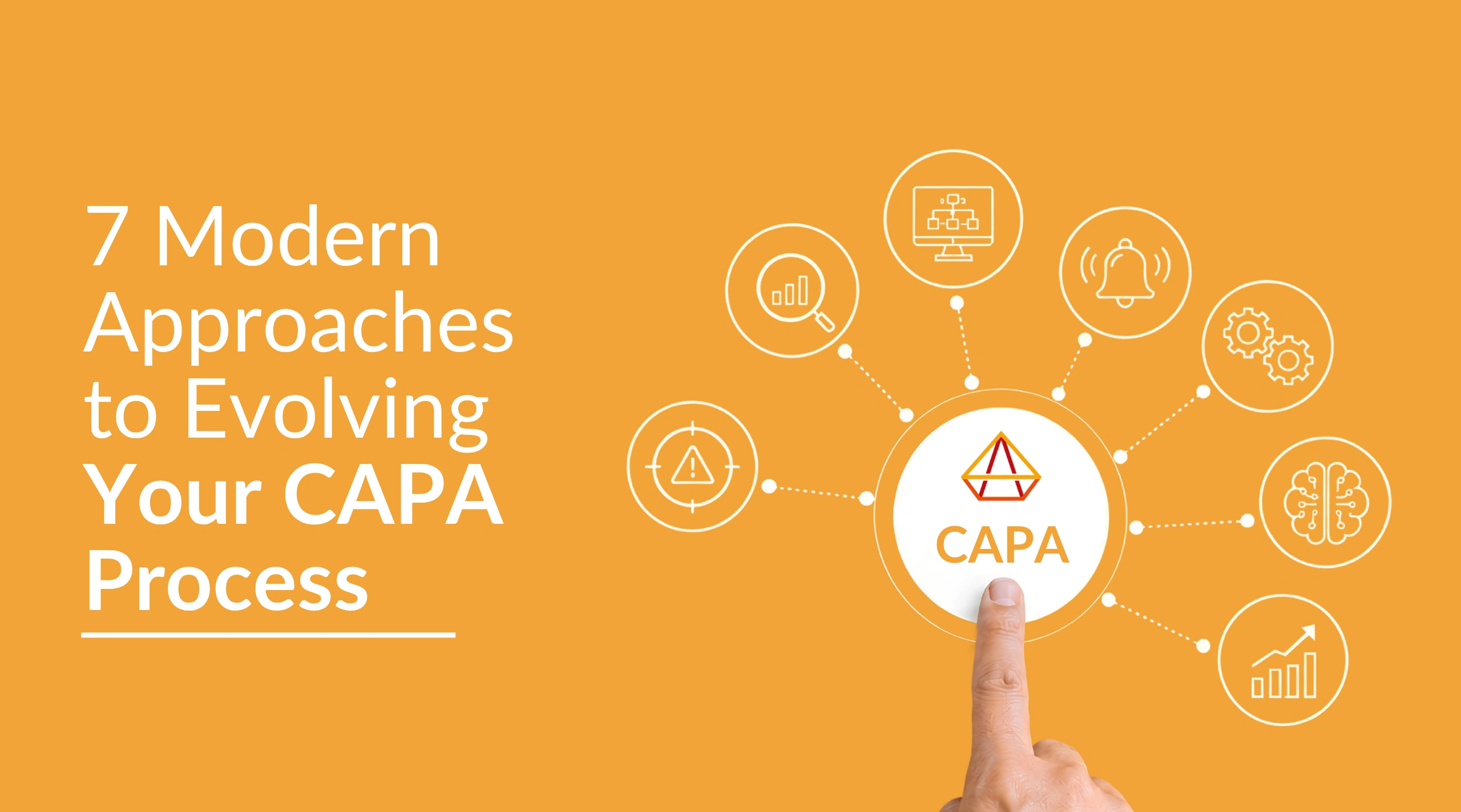
7 Modern Approaches to Evolving Your CAPA Process
There’s a quiet crisis hiding inside most quality management systems.
Teams log non-conformances. Assign owners. Fill in root cause fields. Close the ticket. And then three months later the same defect reappears on the production floor, in a customer complaint or worse, in an audit finding.
The CAPA process corrective and preventive action cycle wasn’t designed to fail. It was designed to be one of the most powerful continuous improvement tools in quality management. But somewhere between the spreadsheet and the sign-off, something breaks.
According to a study by the American Society for Quality (ASQ), nearly 67% of corrective actions fail to prevent recurrence not because teams lack intent, but because their process lacks structure, visibility and the right tools.
This blog goes beyond explaining CAPA fundamentals and explores seven modern approaches that help organizations strengthen problem-solving, improve quality outcomes, and drive continuous improvement more effectively.
First, Why Does Your Current CAPA Process Keep Failing?
Before we talk solutions, let’s call out the real problem.
Most CAPA workflows were built for compliance to satisfy an auditor, not to drive change. They’re reactive by nature, paper-heavy by design and siloed by department. Quality managers spend more time chasing signatures than analysing patterns. Engineers treat root cause fields as a formality, not an investigation.
The result? CAPAs get closed, but problems persist.
The shift from a compliance-driven CAPA to a performance-driven one requires rethinking the process at every stage from how non-conformances are captured, to how root causes are analysed, to how effectiveness is actually verified.
Here’s how modern organizations are making that shift.
1. Treat Non-Conformance Capture as the Foundation, not a Formality
The CAPA process corrective and preventive action lifecycle begins the moment a deviation is identified. And yet, most organizations treat this first step as an afterthought a form to fill before the “real” work begins.
The problem with poor non-conformance capture is that it poisons everything downstream. Vague descriptions lead to shallow root cause analysis. Missing context leads to corrective actions that address symptoms, not sources.
What modern teams do differently:
Modern non-conformance management is structured, consistent and immediate. Instead of relying on memory or batch reporting, teams capture deviations at the point of occurrence with standardized fields that ensure every issue includes what happened, where, when, under what conditions and who was involved.
Leading organizations using digital quality management systems report up to 40% faster CAPA cycle times simply because the initial data captured is complete enough to act on without back-and-forth clarification.
2. Go Beyond 5 Whys Use a Layered Root Cause Analysis Framework
Root cause analysis is where most CAPA processes either earn their value or quietly collapse.
The 5 Whys method is taught in every quality course and used in almost every CAPA. It’s also widely misapplied. Teams stop at the first satisfying answer rather than the actual root, especially under time pressure.
The modern approach is layered:
- Detection root cause Why wasn’t this caught earlier in the process?
- Occurrence root cause Why did this happen in the first place?
- Systemic root cause What in the system allowed the conditions for this to exist?
This three-layer framework, sometimes combined with tools like Fishbone (Ishikawa) diagrams, Fault Tree Analysis, or FMEA linkage, forces teams to think beyond the immediate event and ask: what does this tell us about our system?
Research from the Journal of Quality in Clinical Practice found that organizations using structured, multi-method root cause analysis reduced defect recurrence rates by up to 54% compared to those using single-method approaches.
In regulated industries pharmaceutical, aerospace, medical devices auditors increasingly expect this depth. But more importantly, it actually works.
3. Break Down the Silos Between CAPA and Other Quality Processes
Here’s a pattern that plays out in organizations across industries: the quality team manages CAPAs, the operations team manages production issues and the compliance team manages audit findings and none of them are fully talking to each other.
This fragmentation means that a corrective action raised after an internal audit finding might duplicate work already underway from a customer complaint. Or worse, a CAPA closed in one department resurfaces as a non-conformance in another because the fix was never communicated across the function.
Modern CAPA management systems eliminate this fragmentation by connecting non-conformances, complaints, audit findings and training gaps under a single quality management system umbrella.
When your CAPA Modual is integrated with your complaint management, audit management and document control modules, every corrective action creates a ripple effect automatically flagging related records, triggering training updates where needed and ensuring revised procedures reach the people who need them.
Organizations with integrated quality management systems report 35% fewer repeat non-conformances than those running disconnected point solutions or spreadsheets. The reason is simple: isolated CAPA is incomplete CAPA.
4. Make Preventive Action Actually Preventive Not Just a Checkbox
Here’s an uncomfortable truth: in most CAPA programs, the “P” is silent.
Corrective actions get attention because something has already gone wrong. Preventive actions are supposed to stop problems before they happen but without data, without visibility into trends and without organizational buy-in, they rarely get the same rigor.
The modern approach to preventive action is data-driven:
Instead of waiting for a problem to trigger a CAPA, leading organizations analyse their non-conformance data, customer complaint trends, internal audit findings and near-miss reports to identify where the next problem is likely to emerge.
Think of it as using your quality data as a predictive signal rather than a historical record.
For example: if three different production lines have each reported a minor calibration deviation over the past quarter, a proactive team doesn’t wait for a major non-conformance they initiate a preventive action to audit calibration procedures system-wide.
This shift from reactive to proactive is where CAPA process improvement starts generating real business value, not just compliance checkboxes.
5. Assign Ownership That Means Something
One of the most common failure modes in CAPA management is diffuse ownership.
A CAPA is raised, assigned to “the quality team,” and then sits in someone’s queue for weeks while they wait for input from multiple departments. Nobody escalates because nobody feels fully accountable. Eventually, the CAPA gets closed with a generic corrective action that may not have been fully implemented or verified.
Modern CAPA management is ownership-explicit:
- Every CAPA has a single named owner, not a team or department
- Every task within the CAPA has a designated assignee and deadline
- Escalation paths are defined upfront rather than after delays occur
- Approvals, reviews, and status updates are tracked digitally
A modern CAPA management system also eliminates the inefficiencies of manual approvals and paper-based processes. When a document, corrective action, or review requires approval, automated notifications are instantly sent to the relevant stakeholders. Approvers can review and approve tasks digitally, reducing delays caused by emails, physical paperwork, or manual follow-ups.
With clear ownership, automated notifications, digital approval workflows, and real-time visibility into progress, organizations can reduce administrative effort, accelerate decision-making, and ensure CAPAs move forward without unnecessary bottlenecks. The result is improved accountability, faster closure times, and a more efficient quality management process.
6. Verify Effectiveness and Treat It as a Separate Phase
Ask yourself this: how does your organization currently verify that a corrective action actually worked?
If the answer is “we close the CAPA and wait to see if the problem comes back,” you’re in the majority and that’s precisely why recurrence rates are so high.
Effectiveness verification is the step that transforms a CAPA from a documented response into a confirmed improvement. It’s also the step most often skipped or done superficially.
What genuine effectiveness verification looks like:
- Defined criteria established before the corrective action is implemented what specific metrics will confirm success?
- A scheduled verification checkpoint typically 30, 60 or 90 days after implementation
- Objective evidence: data, audit results, inspection records not just a supervisor’s sign-off
Regulatory bodies including the FDA and ISO 9001 auditors are increasingly scrutinizing effectiveness checks. FDA Warning Letters related to CAPA deficiencies consistently cite lack of effectiveness monitoring as a top finding.
Beyond compliance, verified effectiveness is how your quality data becomes a credible record of improvement rather than a record of activity.
7. Use Data and Trend Analysis to Continuously Improve the CAPA Process Itself
The final and arguably most underutilized modern approach is turning your CAPA data into strategic insight.
Every CAPA your organization runs is a data point. Collectively, they tell a story: which processes generate the most non-conformances, which departments have the highest CAPA completion rates, which types of root causes recur across different product lines and how long each phase of your CAPA cycle actually takes versus how long it should.
This is CAPA process improvement at the system level.
Leading quality teams conduct quarterly reviews of CAPA metrics not just to report on open vs. closed tickets, but to identify systemic patterns and feed that intelligence back into their quality planning. This is what ISO 9001:2015 means when it calls for “continual improvement” not one-off fixes, but a learning system.
Organizations that actively analyse CAPA trends reduce their total cost of quality by an average of 20–30% over a three-year period, according to research published by LNS Research. That’s not a compliance win that’s a business outcome.
Modern CAPA Module makes this analysis accessible. Instead of manually pulling data from spreadsheets, quality managers can view real-time dashboards showing CAPA aging, root cause distribution, departmental performance and recurrence rates turning what used to be a quarterly report exercise into an ongoing strategic tool.
The Common Thread: Your CAPA Process Needs a System Behind It
Looking across these seven approaches, one theme runs through all of them: modern CAPA management is impossible to sustain without the right infrastructure.
Not because people aren’t capable quality professionals understand these principles. But spreadsheets don’t send escalation alerts. Email threads don’t surface trend data. Shared drives don’t connect your CAPA to your audit finding or your training gap.
A purpose-built CAPA management system isn’t a luxury for large enterprises. It’s the foundation that makes everything in this blog post actually executable especially for mid-sized manufacturers, pharmaceutical companies and compliance-driven organizations where quality failures carry real consequences.
The challenge is that implementing these seven approaches consistently becomes increasingly difficult when CAPA activities are managed through disconnected spreadsheets, email threads, and manual approvals. That’s where an integrated digital quality management platform becomes essential.
How Pyraman Supports Every Stage of Your CAPA Process
This is exactly the problem Pyraman was built to solve.
Pyraman is a cloud-based EQMS Software that brings your entire quality process documents, records, non-conformances, audits, complaints, training and objectives under one intelligent platform.
Its NC Management System is purpose-built to support the full CAPA lifecycle:
- Structured non-conformance capture with standardized fields
- Root cause analysis workflows with configurable methodologies
- Role-based task assignment with real-time tracking and escalation
- Effectiveness verification with defined checkpoints
- Cross-module integration with audits, complaints
- Trend dashboards and CAPA analytics for continuous improvement
Whether you’re operating under ISO 9001, IATF 16949, AS 9100, ISO 13485 or any other management system standard, Pyraman adapts to your compliance framework not the other way around.
Trusted by organizations across manufacturing, automotive, aerospace, pharmaceutical, FMCG and ITES sectors, Pyraman gives quality teams the visibility, accountability and intelligence to move their CAPA process from reactive firefighting to proactive quality leadership.
Ready to see it in action? Book a free demo with the Pyraman team and discover how a connected quality management system transforms the way your organization handles corrective and preventive action from the first non-conformance to the final effectiveness check.
Frequently Asked Questions About the CAPA Process
1. What is the CAPA process and Why do CAPA processes fail?
A Corrective and Preventive Action (CAPA) process is a structured quality management approach used to identify non-conformances, determine root causes, implement corrective and preventive actions, and ensure issues do not recur. Many CAPA processes fail because they prioritize documentation and compliance over effective root cause analysis, accountability, collaboration and verification of long-term effectiveness.
2. What are the key stages of the CAPA lifecycle?
- Non-conformance identification.
- Investigation and root cause analysis.
- Corrective action planning.
- Preventive action implementation.
- Effectiveness verification.
- Continuous improvement and trend analysis.
3. What is the CAPA process in quality management?
CAPA (Corrective and Preventive Action) is a structured quality management process used to identify the root causes of defects, non-conformances, or quality failures, implement corrective actions to resolve them and prevent their recurrence through systemic improvements.
4. How is corrective action different from preventive action?
Corrective action addresses a problem that has already occurred identifying why it happened and fixing it. Preventive action is proactive it identifies potential failure points before they cause a non-conformance and eliminates those risks in advance.
5. What are the most common reasons CAPA fails?
The most frequent CAPA failures include superficial root cause analysis, lack of clear ownership, no effectiveness verification, poor data capture at the non-conformance stage and disconnected quality systems that prevent cross-functional visibility.
6. What should a CAPA management system include?
An effective CAPA management system should include non-conformance logging, root cause analysis tools, task assignment and tracking, deadline management with escalation, effectiveness verification workflows and trend reporting and analytics.

More than Thoughts.

Start Your Free 30-Day eQMS Trial
Get full access to Pyraman eQMS for 30 days, free. No commitment, just hands-on document control, audits, and compliance management.
