
Small Inefficiencies, Big Losses: How an eQMS Helps Protect Your Margins
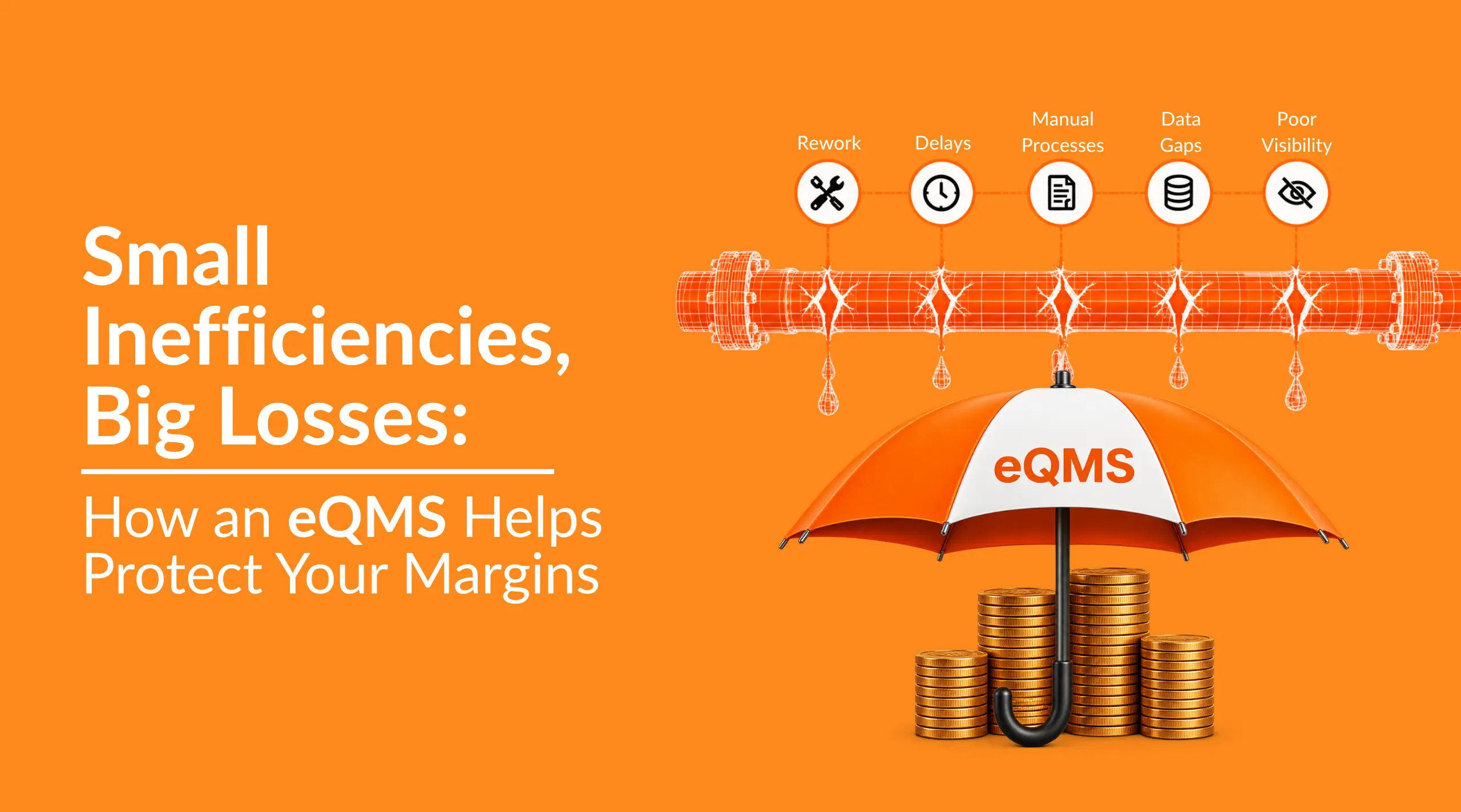
A quality problem does not always arrive as a major failure. Sometimes it starts with a few minutes spent searching for a record, a corrective action that remains open for weeks, a repeated non-conformance or a customer complaint that could have been prevented.
Each issue may seem small on its own. But when the same inefficiencies occur repeatedly, they consume labour, delay operations, increase rework, create administrative effort and gradually reduce margins. This is why quality management is not only about meeting specifications or passing audits. It is also about controlling the hidden costs created by inefficient quality processes.
An eQMS can help organisations bring these processes into a more structured environment, improve visibility and address recurring issues before they continue to affect operational performance and profitability.
In this article, we’ll explore where these hidden quality costs come from, how they affect margins and how an eQMS can help organisations reduce recurring inefficiencies.
What Is the Cost of Quality?
The cost of quality represents the costs associated with preventing quality problems, evaluating conformity and dealing with failures when requirements are not met.
It is generally viewed through four categories:
- Prevention costs – activities designed to prevent defects and failures.
- Appraisal costs – inspection, testing, auditing and other verification activities.
- Internal failure costs – rework, scrap, retesting and other failures identified before delivery.
- External failure costs – complaints, returns, warranty claims and other failures identified after delivery.
The objective of quality cost reduction is not simply to spend less on quality. It is to reduce recurring failure costs by improving the processes that create them.
For a deeper explanation of Cost of Quality and how QMS software can help reduce it, see What Is Cost of Quality: How to Reduce It and How QMS Software Helps.
Where Small Quality Inefficiencies Become Big Losses
Quality-related losses rarely come from one dramatic failure. More often, they accumulate through repeated process inefficiencies. A defect may trigger rework, reinspection, delayed production, corrective action and additional administration. When the same pattern occurs repeatedly, the combined cost can become significant.
1. Rework Creates More Than One Cost
A defective output does not simply require correction. The organisation may need to stop or adjust the process, allocate additional labour, consume replacement material, perform another inspection and obtain approval before the work can continue.
For example, if a recurring dimensional defect requires 30 minutes of rework and 15 minutes of reinspection per unit, the direct cost increases with every affected unit. More importantly, repeated rework can indicate that the process is generating the defect faster than the organisation is eliminating its cause. The margin impact comes from paying twice for work that should have been completed correctly the first time.
2. Scrap Converts Process Failure Into Direct Loss
Scrap represents more than the material that is discarded. By the time a product is rejected, the organisation has already invested labour, machine time, energy, processing effort and inspection resources in producing it.
Instead of looking only at total scrap quantities, organisations should examine which defects are recurring, where they originate and what process conditions are contributing to them. Addressing the source of repeated defects can have a greater impact on margins than simply monitoring the amount of scrap generated.
3. Open Corrective Actions Keep the Problem Active
A corrective action that remains open for weeks is not simply an administrative backlog. Until the underlying cause is effectively addressed, the organisation may continue experiencing the same failure.
This can create repeated investigation and correction, particularly when teams address the immediate symptom but do not verify whether the corrective action has actually prevented recurrence. Tracking action age, recurrence and closure effectiveness can therefore provide more useful insight than simply counting open actions.
4. Quality Administration Can Become a Hidden Labour Cost
Not every quality-related cost appears as rework or scrap. Significant time can also be spent on routine administration, particularly when information is spread across spreadsheets, emails, folders and separate records.
Common examples include:
- Searching for current records
- Following up overdue actions
- Consolidating quality reports
- Collecting audit evidence
- Re-entering information for management reviews
This is productive time being consumed by administration rather than analysis, prevention or process improvement.
5. Customer Complaints Can Multiply the Original Failure Cost
Once a quality problem reaches the customer, the cost can extend well beyond the original defect. Investigation, customer communication, replacement or correction, root cause analysis and corrective action can all require additional resources.
More importantly, recurring complaints may indicate that the underlying process problem has not been effectively addressed. Analysing complaints by product, process, defect type and recurrence can help organisations distinguish isolated incidents from systemic quality problems.
6. Repeated Audit Findings Signal Unresolved Weaknesses
An audit finding should lead to improvement, not simply closure of an observation. When the same or similar finding appears again, the organisation may be spending resources repeatedly on investigation, corrective action, evidence preparation and follow-up without eliminating the underlying weakness.
Looking at recurring findings by process, cause, department and time period can help management identify where the quality management system needs improvement.
The Bigger Picture
These inefficiencies are often connected. A weak process can generate a non-conformance, require rework, create a corrective action, consume additional inspection time and eventually contribute to a customer complaint.
That is why effective quality process improvement should focus on identifying recurring sources of loss, not just correcting individual problems. The earlier an organisation identifies those patterns and addresses their causes, the greater the opportunity to protect its margins.
Why Quality Inefficiencies Often Go Unnoticed
Organisations usually have quality processes in place. The problem is that the information generated by those processes may be spread across different files, systems and teams.
For example, an audit finding may be recorded in one location, the resulting non-conformance in another, supporting evidence in a document folder and follow-up communication through email.
This makes it difficult to answer simple but important questions:
- Which problems are recurring?
- Which corrective actions are taking too long?
- Which findings are repeatedly appearing?
- Where is the most quality-related effort being spent?
- Which issues are having the greatest operational impact?
When quality information remains fragmented, management may see individual problems without seeing the pattern behind them.
Without a connected view of quality information, organisations can correct individual problems without recognising the recurring process weaknesses behind them.
How to Improve Quality Management Without Creating More Work
Improving a quality management system does not necessarily mean adding more inspections, forms or approvals. The goal is to make the existing quality management process more consistent, easier to monitor and less dependent on manual follow-up.
1. Standardise How Quality Issues Are Handled
When different teams record and resolve similar quality problems in different ways, it becomes difficult to compare results or identify recurring weaknesses.
A consistent approach to recording the issue, investigating its cause, assigning corrective actions and verifying closure gives teams a clearer process to follow and makes quality information easier to analyse.
2. Make Ownership and Follow-Up Visible
Assigning an action to someone is not enough if its progress is difficult to monitor. Quality teams need visibility into who is responsible, what needs to be completed, when it is due and whether it has been closed.
Clear ownership and status tracking can reduce repeated follow-up and help prevent important actions from remaining open longer than necessary.
3. Connect Related Quality Information
Quality activities rarely exist in isolation. An audit finding may lead to a non-conformance, which may require corrective action and later verification.
When these activities are maintained separately, teams may have to search through different records to understand the complete history. Connecting related information makes it easier to see what happened, what action was taken and whether the issue was effectively addressed.
4. Look for Recurring Problems, Not Just Individual Issues
The number of quality issues alone does not show where improvement is needed. Organisations should also analyse patterns such as:
- Repeated non-conformance categories
- Recurring audit findings
- Frequently reported complaints
- Long-running corrective actions
- Repeated documentation errors
- Processes generating unusually high numbers of issues
These patterns can reveal where the organisation is repeatedly losing time, resources or quality performance and where process improvement could have the greatest financial impact.
Stop Small Inefficiencies Before They Become Big Losses
Are Quality Inefficiencies Eating into Your Margins?
How an eQMS Can Help Protect Your Margins
The financial value of an eQMS comes from what it helps an organisation improve not from digitisation alone. It comes from helping organisations reduce recurring quality costs, improve process efficiency and act on quality problems before they continue consuming resources.
1. Reduce the Cost of Recurring Quality Problems
Structured non-conformance and corrective action workflows can help teams follow issues from identification through investigation, action and closure. More importantly, consistent records make it easier to identify whether the same problems are appearing repeatedly.
This gives quality teams an opportunity to address the underlying process weakness rather than repeatedly spending resources on the same failure.
2. Reduce Administrative Time
Quality teams can spend significant time searching for records, consolidating information, following up actions and preparing evidence. Centralised documents and records can make this information easier to access and reduce repetitive administrative work.
The value is not simply saving a few minutes on individual tasks. When the same activity is performed hundreds of times, even small reductions in administrative effort can create a meaningful productivity gain.
3. Strengthen Corrective Action Effectiveness
Closing a corrective action does not necessarily mean that the problem has been eliminated. Teams need visibility into responsibilities, due dates, progress and verification to determine whether the action was completed and whether it addressed the underlying issue.
Better follow-up can help reduce overdue actions and identify corrective actions that are repeatedly failing to prevent recurrence.
4. Reduce the Effort Required for Audits
Audit preparation can become resource-intensive when findings, actions, documents and supporting records are maintained separately. A more structured digital environment can make it easier to retrieve evidence and determine the current status of findings and actions.
This can reduce preparation time while giving auditors and management clearer visibility into how quality issues have been addressed.
5. Turn Quality Data into Improvement Opportunities
An eQMS can provide more than a record of individual quality events. When quality information is structured consistently, organisations can look for trends across non-conformances, complaints, audit findings, corrective actions and other quality activities.
Instead of asking only, “How many problems occurred?”, management can ask:
Where are problems recurring? What processes are contributing to them? Which issues require the most resources?
This is where quality process improvement becomes connected to quality cost reduction. The goal is to identify the problems that repeatedly consume resources and prioritise improvement where the financial impact is greatest.
How to Measure Whether Quality Improvements Are Protecting Your Margins
Implementing eQMS software does not automatically reduce quality costs. Organisations need to measure whether their quality management process is actually becoming more effective.
Rather than tracking every possible KPI, focus on measures that connect quality performance with operational cost:
| Measure | What to Look For |
|---|---|
| Rework rate | Is less work being repeated because of quality problems? |
| Scrap rate | Are recurring defects resulting in less material and production loss? |
| NC recurrence | Are the same types of non-conformances appearing repeatedly? |
| Corrective action closure time | Are issues being resolved faster and more consistently? |
| Complaint resolution time | Is the organisation responding to customer issues more efficiently? |
| Repeat audit findings | Are corrective actions preventing similar findings from returning? |
| Record retrieval time | How much effort is required to locate quality evidence? |
| Overdue actions | Are responsibilities and follow-up being managed effectively? |
The most useful approach is to establish a baseline before making process changes and then track whether performance improves over time. This allows organisations to connect quality improvement with measurable operational impact, rather than treating quality data as a separate reporting exercise.
How Pyraman Helps Protect Your Margins
Pyraman brings key quality activities into a structured digital environment, helping organisations manage documents, records, audits, non-conformances, complaints, training, objectives and management actions more systematically. This can reduce process fragmentation and give teams better visibility into issues, actions and supporting information.
By reducing manual coordination and making quality information easier to track and retrieve, Pyraman can help organisations address recurring inefficiencies before they continue consuming time and resources. The focus is not simply on digitisation but on building a more controlled quality management process that supports improvement and operational efficiency.
Ready to Turn Quality Data into Quality Improvement?
See how Pyraman can help your organisation streamline quality processes, improve visibility and reduce avoidable quality costs.
Book Your Personalized Pyraman eQMS Demo →
Frequently Asked Questions
1. How can a company identify hidden quality costs?
Start by looking beyond visible expenses such as scrap and rework. Track the time and resources spent on repeated corrections, delayed actions, complaint handling, audit preparation, record retrieval and recurring quality problems. These activities can reveal quality-related costs that are often not captured as a separate expense.
2. How can an organisation know whether a quality problem is recurring?
Compare quality records over time and look for repeated categories, causes, processes, products, departments or failure modes. A recurring issue is more significant than a single isolated non-conformance because it may indicate that the underlying process has not been effectively improved.
3. Does an eQMS eliminate the need for quality teams?
No. An eQMS supports the work of quality teams; it does not replace their judgement or decision-making. It can reduce manual administration, improve information visibility and provide structured workflows so quality professionals can spend more time on analysis and improvement.
4. How can quality teams justify the investment in eQMS software?
The strongest business case should connect the software to measurable operational problems. For example, organisations can compare the time spent preparing audits, managing corrective actions, retrieving records, handling recurring non-conformances or preparing reports before and after digitisation.
5. What should be improved before implementing an eQMS?
Organisations should first understand their existing quality processes, identify recurring inefficiencies, clarify responsibilities and determine which activities create the greatest operational burden. Digitising a poorly defined process without addressing its underlying weaknesses may simply move the same inefficiency into a digital system.
6. How does quality management affect profitability?
Quality management affects profitability through both prevention and failure costs. Effective processes can reduce scrap, rework, delays, complaints, returns, repeated corrective actions and administrative effort, while also helping organisations maintain consistent product and service quality.

Start Your Free 30-Day eQMS Trial
Get full access to Pyraman eQMS for 30 days, free. No commitment, just hands-on document control, audits, and compliance management.
