
Quality Management Challenges in Multi-Plant Manufacturing and How eQMS Solves Them
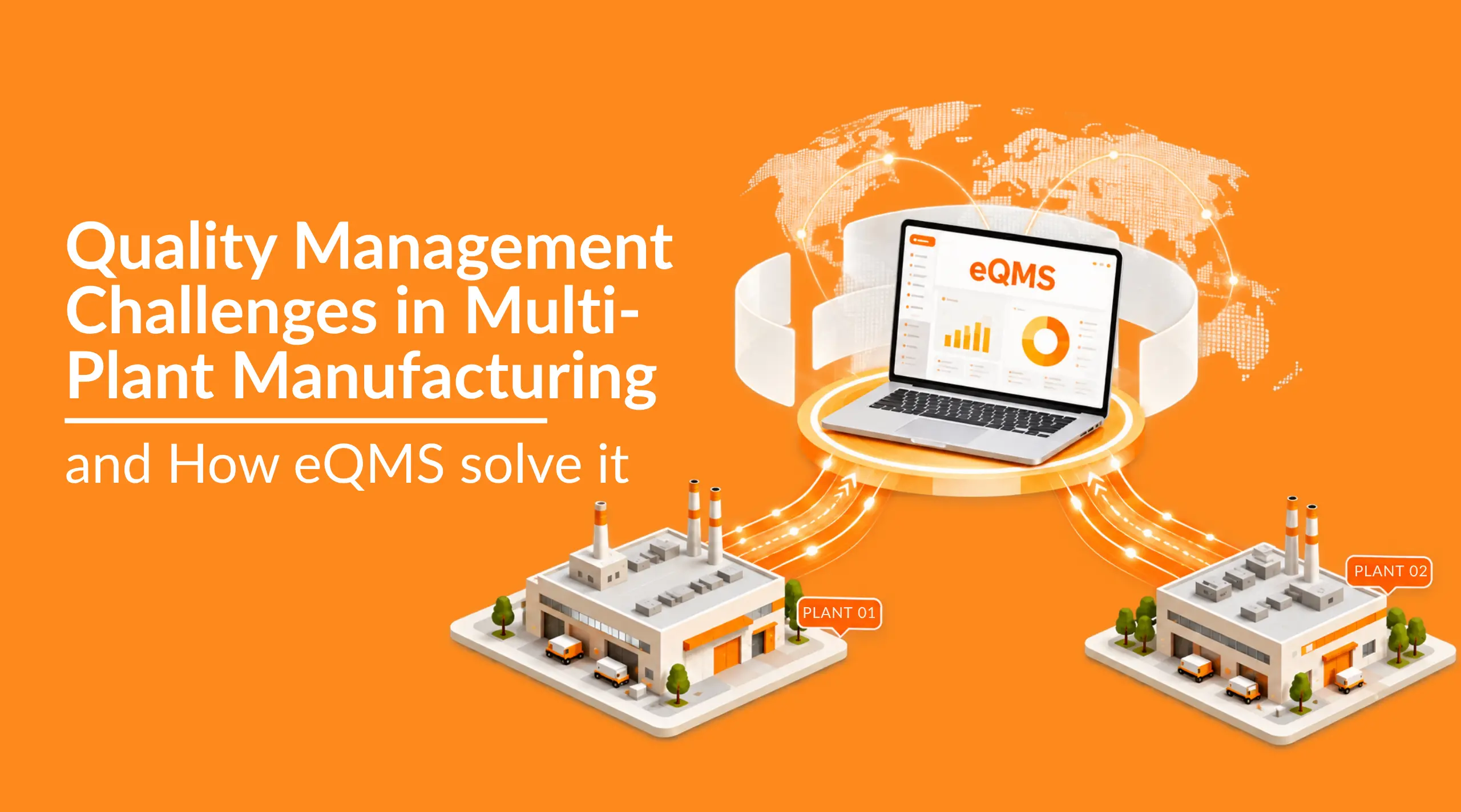
Managing quality in one manufacturing plant is challenging enough. Add multiple plants, different teams, local processes and separate quality records, and maintaining consistency becomes much harder.
A document revision at one location, a recurring non-conformance at another, or an overdue audit action can quickly become difficult to track when quality information is spread across folders, spreadsheets, emails and plant-level systems. This is where eQMS software for manufacturing can help create a more structured approach to multi-plant quality management.
In this blog, we’ll explore the key quality challenges faced by multi-plant manufacturers, how eQMS can address them, what to look for when choosing an eQMS, centralized vs plant-specific QMS approaches, and how Pyraman supports quality management across multiple plants.
Why Multi-Plant Manufacturing Creates Quality Management Challenges
When quality management is handled within a single plant, teams can usually work closely around the same documents, processes, records and quality activities. As operations expand to multiple locations, however, the same quality system has to function across different teams, production environments and plant-level responsibilities.
Each plant may develop its own way of maintaining documents, recording non-conformances, preparing for audits or tracking employee training. These differences may not be obvious at first, but over time they can make it harder for the organization to maintain consistent quality practices across locations.
Quality information can also become distributed across shared folders, spreadsheets, emails and separate plant-level systems. This makes it harder for corporate quality teams to understand what is happening across the organization without manually collecting and consolidating information.
The challenge, therefore, is not simply having more plants. It is maintaining one consistent quality approach while giving individual plants the flexibility to manage their day-to-day operations.
7 Common Quality Management Challenges Across Multiple Plants
1. Maintaining Consistent Quality Processes Across Plants
A procedure may be standardized at the corporate level, but its execution can vary from one plant to another. Differences in interpretation, local workarounds or informal practices can gradually create variations in how quality activities are performed.
For example, two plants may follow the same non-conformance procedure but use different methods to record findings, assign follow-up activities or document closure. When these differences grow, comparing quality performance across plants becomes more difficult.
Manufacturers therefore need a way to establish common quality workflows while still allowing plant teams to execute processes according to their operational responsibilities. The objective is not to make every plant identical, but to create a consistent framework for managing core quality activities.
2. Controlling Quality Documents Across Multiple Locations
Document control becomes more complicated when the same SOPs, work instructions and quality procedures are used across several plants. A revised document may be approved centrally, but individual locations still need access to the correct version.
Without effective version control, different plants may continue using older copies stored in local folders, email attachments or downloaded files. This creates uncertainty around which document is currently approved and whether the latest revision has reached the people who need it.
A QMS for multiple plants should therefore provide a structured approach to document creation, review, approval, revision and access. For manufacturers, this is one of the areas where eQMS software for manufacturing can help bring greater consistency to quality documentation.
3. Managing Non-conformances Across Different Plants
Non-conformances are often recorded at the plant where an issue occurs. While this makes sense operationally, keeping those records completely separate can make it difficult to identify whether similar problems are occurring elsewhere.
For instance, if the same type of non-conformance appears at three different plants, corporate quality teams may need to review records from each location separately before recognizing the pattern. Manual follow-up can also make it difficult to know which issues remain open and which actions have been completed.
A multi-plant quality system needs to maintain plant-level ownership while providing appropriate visibility across locations. This can help quality teams review non-conformances as individual plant issues as well as part of the organization’s broader quality performance.
4. Coordinating Audits and Follow-Up Across Plants
Multi-plant manufacturers may have internal audits, customer audits and other quality assessments taking place at different locations and on different schedules. Each audit can generate findings, actions, evidence and follow-up activities that need to be tracked until closure.
When this information is maintained separately by each plant, corporate quality teams may have to collect updates manually to understand the overall audit status. It can also become difficult to quickly identify which findings are still open or where follow-up is overdue. A structured audit management process can help organizations maintain audit information in a consistent format while allowing individual plants to manage their own audit activities and findings.
5. Keeping Training and Competency Records Consistent
Quality processes depend on employees understanding the procedures they are expected to follow. Across multiple plants, however, training records may be maintained independently by different teams or through different methods. This can create questions such as whether employees have completed training for a revised procedure, which plant has outstanding training requirements, or whether training records can be quickly retrieved when needed.
Centralizing training information can give quality teams a clearer way to track training activities across locations while allowing plant teams to manage employee-specific requirements. It also creates a stronger connection between controlled quality documents and the training associated with those processes.
6. Getting a Consolidated View of Quality Performance
For corporate quality teams, one of the biggest challenges in a multi-plant environment is simply knowing what is happening across all locations.
Management may need answers to questions such as:
- Which plants have the highest number of open non-conformances?
- Which audit findings are still awaiting action?
- Where are quality objectives not progressing as expected?
- Are similar quality issues appearing at more than one plant?
- Which quality activities require attention from the corporate team?
When information is maintained separately, answering these questions may require data to be collected from individual plants and consolidated manually. A more connected quality environment can reduce this dependence on manual consolidation by making relevant quality information available within a structured system. The aim is not to replace plant-level decision-making, but to give management a clearer basis for understanding quality activities across the organization.
7. Maintaining Traceability Across Multiple Locations
Quality activities are rarely isolated. A document revision may lead to employee training, an audit finding may result in a non-conformance, and a recurring non-conformance may require a change to an existing procedure.
When these activities are managed through separate systems or disconnected files, reconstructing the history of an issue can take considerable effort. Teams may need to search through emails, spreadsheets, shared folders and individual plant records to establish what happened. For multi-plant manufacturers, traceability means being able to follow the relevant quality information across its lifecycle from the controlled document or quality record to the associated audit, non-conformance, training or follow-up activity.
This is where eQMS for multi-plant manufacturing can provide a more connected approach to quality management. Instead of treating each plant’s quality activities as completely separate information, organizations can establish structured processes that support both local execution and broader quality visibility.
How eQMS Solves Quality Management Challenges in Multi-Plant Manufacturing
An eQMS can address many of the coordination problems that arise when quality activities are spread across multiple manufacturing locations. The objective is not to take control away from individual plants, but to provide a common quality environment in which documents, records, audits, non-conformances and training activities can be managed through structured processes. For a multi-plant manufacturer, this creates a balance between plant-level execution and organization-wide quality visibility.
1. Centralizes Quality Information Across Plants
When each plant maintains quality information in separate folders, spreadsheets or systems, corporate teams may need to collect information manually to understand the overall quality status.
An eQMS brings relevant quality information into a structured environment. Documents, quality records, audit information, non-conformances and training activities can be managed within defined quality processes rather than being scattered across individual locations. This gives teams a common place to access the information relevant to their responsibilities while maintaining appropriate access controls for different users and locations.
2. Standardizes Document and Approval Workflows
Maintaining the same quality documentation across multiple plants requires more than distributing a file. Organizations need to control how documents are created, reviewed, approved, revised and made available for use.
With an eQMS, manufacturers can establish defined workflows for these activities. When a controlled procedure is revised, the review and approval process can follow a structured sequence, while revision history helps distinguish the current version from previous versions. This reduces dependence on email-based approvals, manually maintained version names and separate document registers.
3. Creates a Structured Approach to Non-conformance Management
A non-conformance still belongs to the plant where it occurs, but the information does not necessarily need to remain isolated there.
An eQMS can provide a structured workflow for recording the issue, assigning responsibility, tracking actions and documenting closure. Plant teams can manage their own non-conformances while quality teams can maintain broader visibility into the organization’s non-conformance activities. This also makes it easier to review whether similar issues are occurring at different locations rather than treating every plant’s quality data as completely disconnected.
4. Simplifies Multi-Plant Audit Management
Audits across multiple plants generate schedules, findings, follow-up activities and supporting records that need to remain traceable. An eQMS can provide a structured environment for managing these audit activities, allowing teams to record findings and track follow-up actions through defined workflows. Individual plants can manage their audit responsibilities while relevant quality teams can access the information needed for broader oversight. Instead of relying on separate spreadsheets or manually consolidated audit reports, organizations can maintain audit information within a common quality system.
5. Connects Training with Quality Processes
Changes to quality documents and processes can create corresponding training requirements. If training records are managed independently at each plant, it can become difficult to determine whether employees have completed the training associated with a revised procedure.
An eQMS with training management can help organizations track training activities within the same quality environment. This provides a clearer connection between controlled quality information and the employees who need to understand or follow it. For multi-plant manufacturers, this can help quality teams identify training status across locations without requiring every plant to maintain completely separate tracking methods.
6. Improves Quality Visibility and Traceability
The biggest advantage of connecting quality activities is not simply having more information in one system. It is being able to follow quality information across related activities. A document revision may lead to training. An audit finding may result in a non-conformance.
A recurring non-conformance may require a change to a procedure. When these activities are managed through structured quality processes, it becomes easier to understand the relationship between them. For organizations operating multiple plants, this creates a more traceable quality environment while allowing individual locations to retain responsibility for their own day-to-day activities.
What Should Manufacturers Look for in eQMS Software for Multiple Plants?
Choosing eQMS software for manufacturing requires looking beyond the number of modules a vendor offers. For a multi-plant organization, the more important question is whether the software can support common quality processes while accommodating different users, locations and responsibilities.
- Centralized Document Management: The system should support controlled documents, revisions, approvals, access and document history so that different plants can work with the appropriate quality information.
- Quality Record Management: Manufacturers should be able to organize and retrieve quality records without depending on separate plant-level repositories.
- Non-conformance Management: Look for structured workflows that allow plants to record, assign, track and close non-conformances while providing appropriate visibility to quality teams.
- Audit Management: The system should support audit planning, findings, follow-up and historical information across different locations.
- Training Management: Training management should make it easier to track employee training activities and identify outstanding requirements related to quality processes.
- Role-Based Access and Workflow Control: A multi-plant system may involve corporate quality teams, plant managers, quality personnel and other users. Access and workflow controls should therefore reflect the responsibilities of different users.
- Traceability and Revision History: Look for clear histories of document revisions, approvals, activities and relevant quality records so that information can be reconstructed when required.
- Quality Objectives and Monitoring: The system should support the organization in defining and tracking quality objectives rather than treating quality performance as a collection of disconnected plant-level spreadsheets.
- Cross-Functional Collaboration: Quality activities often involve production, engineering, HR, management and other functions. The software should support collaboration across these teams without requiring information to be transferred manually between systems.
- Scalability as Additional Plants Are Added: A system that works for two plants should not become difficult to manage when the organization expands. Consider how users, locations, documents, workflows and quality activities can be accommodated as operations grow.
Centralized QMS vs Plant-Specific Quality Systems
Both approaches can support manufacturing quality management, but they organize information and oversight differently.
| Plant-Specific Quality Systems | Centralized eQMS |
|---|---|
| Quality information remains separated by location. | Quality information is managed within a common environment. |
| Processes may develop differently across plants. | Common workflows can be established across locations. |
| Corporate reporting may require manual consolidation. | Relevant quality information can be accessed through the same system. |
| Each plant may maintain separate document repositories. | Controlled documents can be managed through a centralized system. |
| Cross-site traceability can require information from multiple sources. | Related quality activities can be maintained within connected workflows. |
A centralized eQMS does not mean every plant has to operate in exactly the same way. Plant teams can continue managing their own operational responsibilities while the organization establishes common controls for activities such as document management, records, audits, non-conformances and training. The objective is to create consistency where it matters and flexibility where it is necessary.
How Pyraman Supports Quality Management Across Multiple Plants
Pyraman provides a centralized QMS that helps multi-plant manufacturers manage key quality activities through one structured platform. Its Document Management System, Record Management System, NC Management System, Audit Management System, Training Management System, Objective Management System, Complaint Management System and MoM Management Systems support essential quality processes across multiple locations.
By bringing these processes into one connected environment, Pyraman can help manufacturers reduce fragmented quality management and improve consistency, traceability and visibility across locations.
Want to bring your multi-plant quality processes into one structured system? Contact us or book your free personalized Pyraman eQMS demo today.
Frequently Asked Questions
1. Can different manufacturing plants use the same eQMS while following different processes?
Yes. A multi-plant eQMS can provide a common quality framework while allowing individual plants to maintain processes that are specific to their products, operations or responsibilities. The key is to standardize the quality controls that need to remain consistent without forcing every plant to operate identically.
2. Who should manage an eQMS when a company has multiple manufacturing plants?
Responsibility is usually shared between corporate quality teams and plant-level quality teams. Corporate teams can establish common quality processes and governance, while individual plants manage day-to-day quality activities within their areas of responsibility. Defining these responsibilities before implementation helps prevent confusion over who owns documents, audits, non-conformances and training activities.
3. Can a company roll out an eQMS to one plant before implementing it across all locations?
Yes. A phased rollout can allow a manufacturer to test workflows, identify process gaps and incorporate feedback before expanding the system to additional plants. This approach can also make user training and change management more manageable when multiple locations are involved.
4. How long does it take to implement an eQMS across multiple manufacturing plants?
There is no single implementation timeline. It depends on factors such as the number of plants, users, existing quality processes, document volume, data migration requirements and the extent of workflow configuration. A multi-plant rollout generally requires more planning than a single-site implementation because processes and responsibilities need to be aligned across locations.
5. Can an eQMS work with an existing ERP or manufacturing system?
Integration depends on the eQMS platform and the systems already used by the manufacturer. Before selecting a solution, manufacturers should identify which quality information needs to remain within the QMS and whether any data needs to be exchanged with ERP, MES or other business systems. Any required integration should be confirmed with the software provider during the evaluation process.
6. How do you get employees at different plants to adopt the same eQMS?
Successful adoption requires more than software deployment. Manufacturers should involve plant-level users during workflow design, provide role-specific training and explain how the system will affect their existing quality activities. Giving plants a clear understanding of what is standardized centrally and what remains under local responsibility can also reduce resistance to the new system.
7. What happens when a company acquires a manufacturing plant with a different quality system?
The organization should first assess the acquired plant’s existing documents, workflows, records and responsibilities before deciding what should be standardized or migrated. An eQMS can provide a common framework for bringing quality activities together, but the implementation should account for differences in processes and existing quality information rather than simply transferring everything without review.
8. Can an eQMS support manufacturers as they add new plants?
A scalable eQMS should be able to accommodate additional users, locations, documents, records and quality activities as the organization grows. Manufacturers should therefore evaluate how easily a new plant can be introduced into existing quality workflows and access structures before selecting a platform.


Start Your Free 30-Day eQMS Trial
Get full access to Pyraman eQMS for 30 days, free. No commitment, just hands-on document control, audits, and compliance management.
