
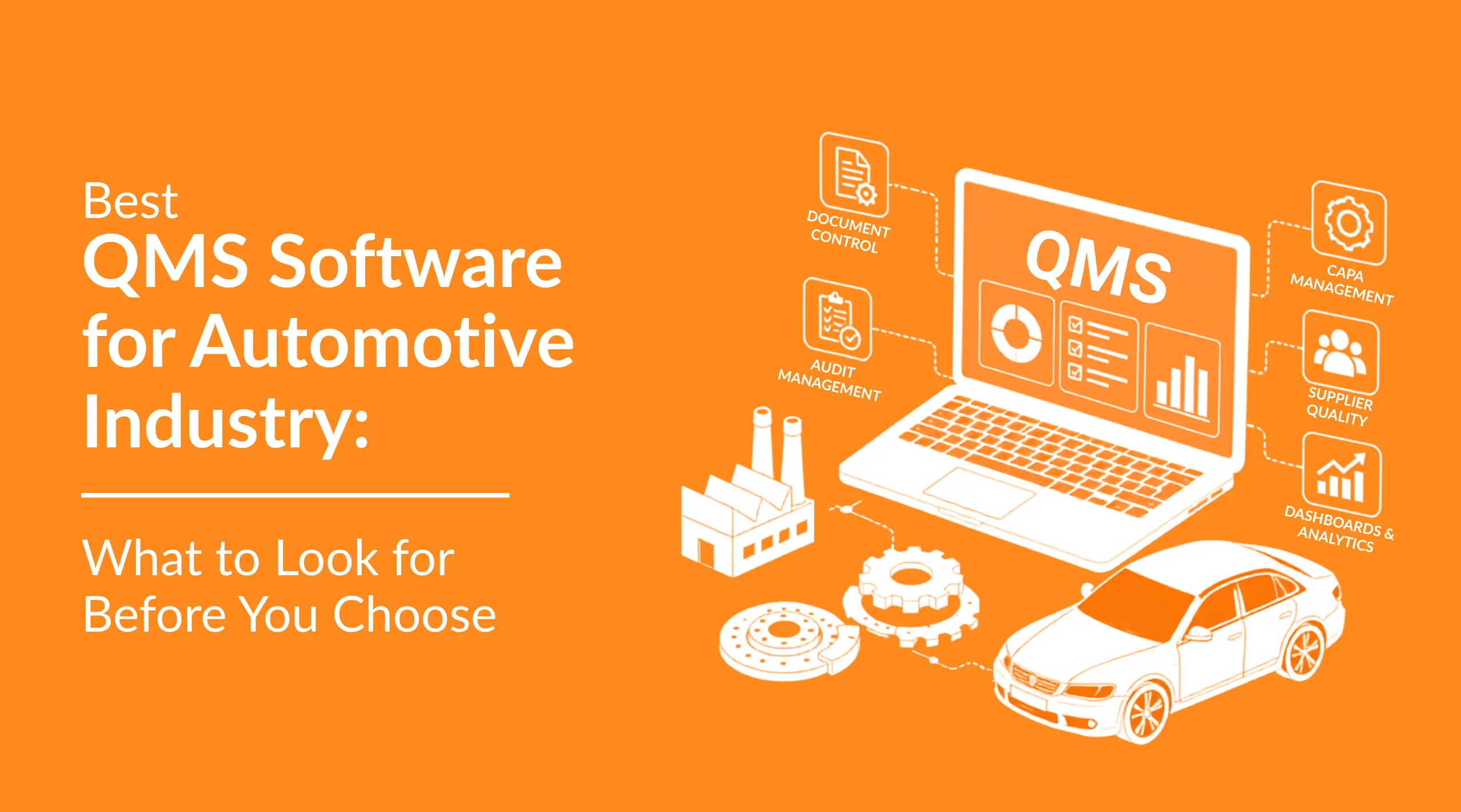
Best QMS Software for Automotive Industry: What to Look for Before You Choose
In automotive manufacturing, quality failures don’t stay on the shop floor they end up on the road, in recall notices and in boardroom conversations about cost.
GM, Ford and Tesla alone spent $10 billion on warranty claims and recalls in a single year, according to industry data cited at the Society of Automotive Analysts’ Recall Summit. Behind most of those figures is a common thread: quality processes that couldn’t catch, track or resolve issues fast enough.
This is where a structured QMS makes the difference. Automotive manufacturers whether producing components, assemblies or finished vehicles operate under some of the strictest quality and compliance requirements in any industry. Managing audits, non-conformances, corrective actions and quality documentation manually is no longer practical at that scale.
In this blog, we’ll explore the key quality challenges automotive manufacturers face, what to look for in a QMS platform and how the right system helps teams stay compliant, reduce defects and build a culture of continuous improvement.
Why Automotive Manufacturers Need More Than a Basic QMS
Every manufacturing business focuses on quality but automotive manufacturers operate in an environment where expectations are significantly higher. Customers demand zero-defect products; regulatory requirements continue to evolve and supply chains involve hundreds of suppliers contributing thousands of components to a single vehicle.
A basic Quality Management System may help manage documents or inspections but it often lacks the integrated capabilities needed to support the complexity of automotive manufacturing.
When evaluating the best QMS software for automotive industry, manufacturers should look beyond basic compliance and consider whether the software can support end-to-end quality management from quality documentation, audits, non-conformances, corrective actions and customer complaints.
Below are some of the key challenges automotive manufacturers face and why an integrated Quality Management System makes a difference.
1. Controlling Quality Documents and Records
Automotive manufacturers rely on a wide range of quality documents, including Standard Operating Procedures (SOPs), work instructions, inspection reports, control plans and quality records. Managing these documents through spreadsheets or disconnected systems often leads to outdated versions, inconsistent processes and compliance risks.
Without proper document control, employees may unknowingly use obsolete information, increasing the likelihood of quality issues and operational inconsistencies.
A modern Quality Management System centralizes document and record management with version control, approval workflows, controlled user access and complete traceability. This ensures employees always have access to the latest approved documents while simplifying compliance and improving operational consistency.
2. Managing Internal and External Audits Efficiently
Automotive manufacturers regularly undergo internal audits, customer audits and certification audits to verify compliance with IATF 16949 and customer-specific quality requirements. Coordinating audit schedules, managing findings and tracking corrective actions manually can result in missed deadlines, inconsistent follow-ups and increased audit preparation efforts.
An integrated Quality Management System streamlines the entire audit process by standardizing audit planning, scheduling, execution and reporting within a centralized platform. It also helps organizations track findings, assign corrective actions and maintain complete audit records, making it easier to stay audit-ready throughout the year rather than preparing only when an audit is announced.
3. Meeting IATF 16949 and Customer-Specific Requirements
Automotive manufacturers must comply with internationally recognized standards such as IATF 16949, while also meeting customer-specific quality requirements from OEMs and Tier suppliers.
Achieving compliance requires organizations to maintain controlled documentation, conduct regular internal audits, monitor corrective actions, evaluate risks and demonstrate continuous improvement.
Managing these activities through manual processes increases the likelihood of inconsistent documentation, missed deadlines and audit findings. A digital QMS simplifies compliance by connecting these quality processes within a single, standardized system.
4. Responding Faster to Quality Issues
Quality issues become significantly more expensive when they remain unresolved. Delayed investigations, incomplete corrective actions or poor communication between departments often result in recurring defects and higher operational costs.
An integrated Quality Management System enables organizations to capture quality issues as they occur, assign responsibilities automatically, monitor corrective actions and verify effectiveness before closing the issue. This structured approach helps manufacturers resolve problems faster while reducing repeat failures.
5. Improving Collaboration Across Departments
Quality isn’t owned by one department alone. Production, quality assurance, engineering, procurement, maintenance and suppliers all contribute to delivering consistent product quality.
When each team relies on separate spreadsheets or standalone applications, collaboration becomes slower and information gaps become more common.
The right QMS provides a centralized platform where quality data, audit findings, documents and corrective actions are shared securely across departments. This enables faster decision-making, greater accountability and a more consistent approach to quality management throughout the organization.
Why Choosing the Right QMS Matters
Not every Quality Management System offers the same capabilities. While some solutions focus only on document control or audit management, others provide an integrated platform that connects every critical quality process into a single ecosystem.
For automotive manufacturers, selecting the right solution isn’t about finding software built exclusively for the automotive sector it’s about choosing a flexible, scalable QMS that supports the industry’s quality requirements while adapting to future business needs.
Essential Features of the Best QMS Software for the Automotive Industry
1. Centralized Document & Record Management
Quality documents form the backbone of every automotive manufacturing process. Standard Operating Procedures (SOPs), work instructions, inspection reports, control plans and quality records must always remain accurate, controlled and easily accessible.
Managing these documents manually often results in outdated versions, duplicate records and inconsistent practices across production facilities, increasing compliance risks and making audit preparation time-consuming.
A robust automotive QMS should provide:
- Version-controlled document management
- Digital approval workflows
- Controlled user access
- Centralized quality records
- Complete document traceability
By ensuring employees always work with the latest approved documents, manufacturers can reduce process variation, improve product consistency and stay audit-ready.
Business impact
- Faster audit preparation
- Better document control
- Reduced compliance risks
- Improved operational consistency
Pyraman centralizes documents and quality records in a secure, version-controlled environment, enabling manufacturers to maintain document integrity while simplifying compliance and audits.
More than a Free Trial.
Ready to Simplify Quality Across Your Automotive Operations?
2. Integrated Audit Management
Internal, customer and certification audits are essential for maintaining compliance and identifying opportunities for continuous improvement. However, manually managing audit schedules, checklists and findings often leads to missed audits, inconsistent execution and delayed follow-ups.
An effective QMS should help manufacturers:
- Plan and schedule audits
- Assign auditors automatically
- Standardize digital audit checklists
- Record findings electronically
- Generate audit reports instantly
Instead of treating audits as isolated activities, organizations can integrate them into everyday quality management.
Business impact
- Improved audit readiness
- Reduced audit findings
- Better compliance
- Greater visibility into audit performance
Pyraman’s Audit Management module automates audit planning, standardizes workflows and provides complete visibility into findings, corrective actions and audit performance.
3. Non-Conformance (NC), CAPA & Complaint Management
Quality issues rarely exist in isolation. A customer complaint may uncover a production defect, which leads to a non-conformance investigation and ultimately requires corrective and preventive actions. Managing these processes separately creates delays, duplicate work and recurring quality problems.
An integrated QMS should enable manufacturers to:
- Capture non-conformances digitally
- Record customer complaints centrally
- Perform root cause analysis
- Assign and monitor CAPAs
- Verify corrective action effectiveness
- Track overdue actions
- Maintain complete traceability
Connecting complaints, non-conformances and CAPA within a single workflow enables manufacturers to resolve issues faster, eliminate recurring defects and strengthen customer confidence.
Business impact
- Reduced defects, scrap and rework
- Faster issue resolution
- Lower recurring quality problems
- Greater accountability
- Improved customer satisfaction
Pyraman seamlessly connects Complaint Management, Non-Conformance Management, CAPA, audits and quality records, providing complete visibility from issue identification through investigation, corrective action and effectiveness verification.
4. Employee Training & Competency Management
Even the best quality processes depend on employees applying them consistently. Auditors routinely verify training records and employee competency to ensure personnel are qualified to perform their assigned responsibilities.
A modern QMS should enable organizations to:
- Schedule training
- Track employee competency
- Maintain digital training records
- Monitor certification validity
- Send automated reminders
Keeping training, records centralized helps manufacturers maintain workforce competency while simplifying compliance and audit preparation.
Business impact
- Better workforce competency
- Consistent process execution
- Easier compliance verification
- Reduced operational risks
Pyraman’s Training Management module enables organizations to manage employee training, competency assessments and qualification records from a centralized platform.
5. Real-Time Dashboards, Analytics & Quality Process Traceability
Quality data is valuable only when it is transformed into actionable insights. A connected QMS should provide real-time visibility into quality performance while maintaining complete traceability across documents, audits, quality records, CAPAs and corrective actions.
Manufacturers should be able to monitor:
- Audit performance
- CAPA status
- Customer complaints
- Non-conformance trends
- Quality KPIs
- Connected quality records
- Complete audit trails
Real-time analytics help management identify recurring issues, evaluate improvement initiatives and make informed decisions before quality problems affect production or customers. At the same time, complete traceability enables faster investigations, supports compliance and ensures critical quality information is always accessible.
Business impact
- Better management decisions
- Early identification of quality risks
- Improved cross-functional collaboration
- Complete process traceability
- Continuous improvement
Pyraman’s integrated eQMS connects documents, audits, quality records, dashboards and workflows on a centralized platform, giving organizations complete visibility across their quality operations.
Why Automotive Manufacturers Choose Pyraman
Pyraman’s integrated eQMS brings every quality function audits, CAPAs, documents and complaints into one centralized platform, giving automotive manufacturers the visibility, traceability and control they need to stay compliant and competitive.
With Pyraman, automotive manufacturers can:
- Centralize documents and quality records with secure version control
- Manage internal and customer audits on a single platform
- Digitize CAPA and Non-Conformance workflows with full traceability
- Track customer complaints from reporting through to resolution
- Maintain employee training and competency records
- Monitor quality KPIs through real-time dashboards
- Generate audit-ready reports instantly
And because Pyraman is a flexible enterprise eQMS, it scales with your operations whether you’re adding facilities, entering new markets or managing growing compliance requirements.
Build a Smarter Quality Management System Starting Today.
Book a free demo and see how Pyraman helps automotive manufacturers improve quality, strengthen compliance and drive continuous improvement across every operation.
Frequently Asked Questions (FAQs)
1. Why do automotive manufacturers need a Quality Management System?
A Quality Management System helps automotive manufacturers standardize processes, improve traceability, reduce defects, simplify audits and maintain compliance with customer and industry requirements.
2. What features should I look for when choosing QMS software?
Look for features such as:
- Document Management
- Audit Management
- Record Management
- CAPA
- Non-Conformance Management
- Training Management
- Dashboards & Analytics
3. How does a QMS help with IATF 16949 compliance?
A QMS supports IATF 16949 by helping organizations control documented information, manage internal audits, monitor corrective actions, maintain training records and demonstrate continual improvement through standardized quality processes.
4. Can a generic QMS support automotive manufacturing?
Yes. A flexible, configurable enterprise QMS can effectively support automotive manufacturing when it provides capabilities such as audit management, CAPA, document control, complaint management and traceability. Industry-specific software isn’t always necessary if the platform can adapt to automotive quality requirements.
5. Is cloud-based QMS software suitable for automotive manufacturers?
Yes. Cloud-based QMS solutions provide centralized access to quality information, improve collaboration across multiple locations and simplify system updates while maintaining secure access to quality records.



Start Your Free 30-Day eQMS Trial
Get full access to Pyraman eQMS for 30 days, free. No commitment, just hands-on document control, audits, and compliance management.
