
eQMS Software for FMCG Industry: Managing Quality When Product Portfolios Keep Changing
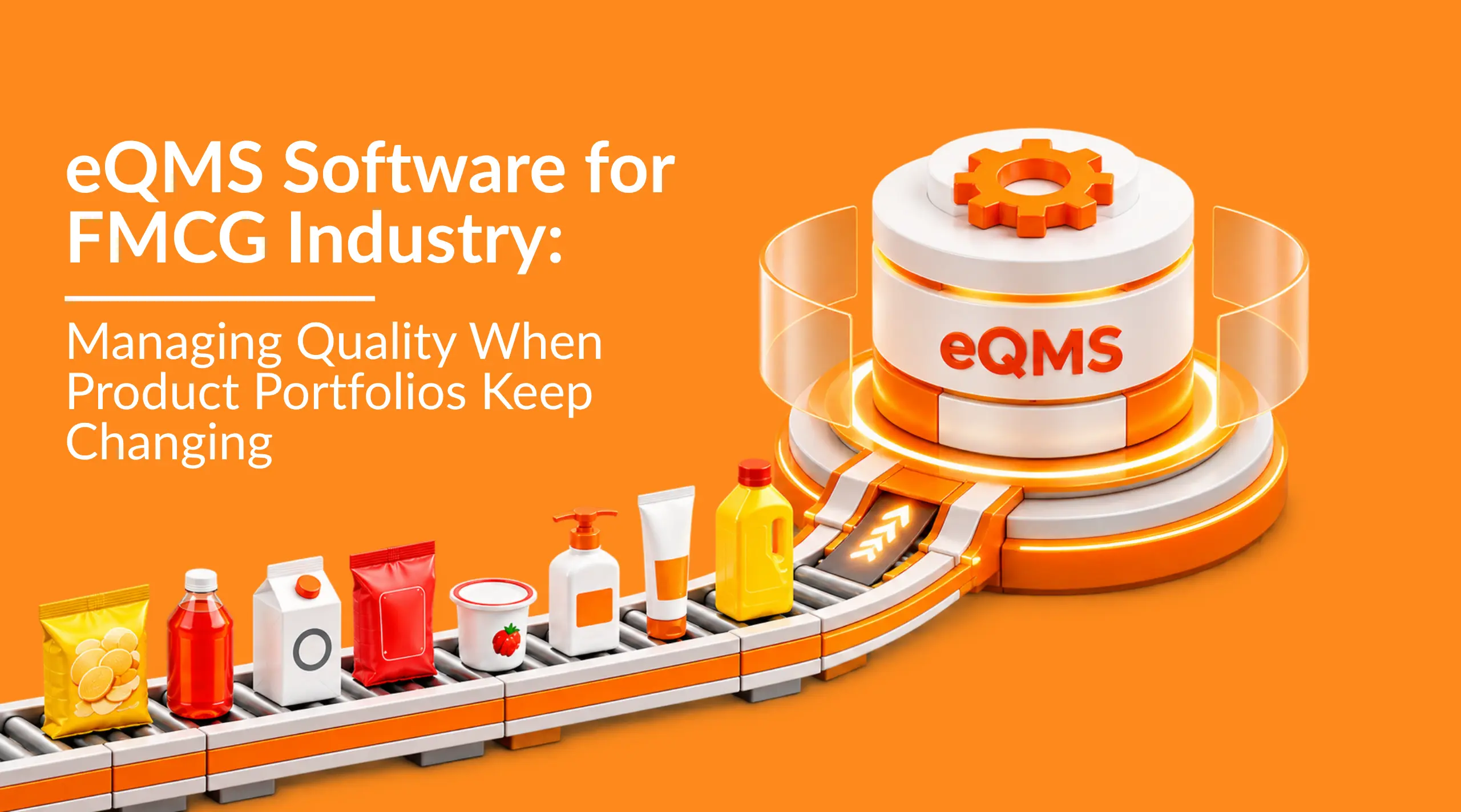
In the FMCG industry, change is constant. New SKUs are introduced, pack sizes are modified, packaging is updated, and formulations evolve. As the product portfolio grows, so does the quality information that needs to remain accurate and controlled.
A single product change can affect documents, employee training, quality records, complaints, non-conformances and audit evidence. Managing these across spreadsheets, shared folders and emails can make it difficult to keep quality processes aligned with product and process changes.
This is where eQMS software for FMCG industry can help. By bringing key quality processes into a structured digital environment, an eQMS helps FMCG organizations maintain control, consistency and traceability as their product portfolios evolve.
In this blog, we’ll look at the quality challenges created by constantly changing product portfolios, how eQMS can help address them, what FMCG companies should consider before digitizing their quality processes, and how Pyraman supports quality management in a growing FMCG environment.
Why FMCG Product Changes Create Quality Management Complexity
In FMCG, a product change rarely affects just one activity. A new SKU, packaging update, formulation change or product variant can require updates to quality documents, employee training, records and other quality activities.
When these activities are managed across spreadsheets, shared folders and emails, keeping information accurate, current and accessible becomes more difficult. These challenges become more visible as the product portfolio continues to grow.
1. Keeping Product-Related Quality Documents Under Control
Every new SKU or product variant can introduce additional SOPs, work instructions, specifications, forms and other controlled documents. Existing products may also go through packaging, formulation or process changes that require document revisions. The challenge is not simply storing these documents. Quality teams need to ensure that the current approved version is available to the right people while outdated versions remain controlled.
When documents are managed across shared folders, spreadsheets and email, keeping track of revisions becomes increasingly difficult as the product portfolio grows.
2. Managing the Growing Volume of Quality Records
More products and processes naturally generate more quality records.
These may include:
- Inspection and quality records
- Production-related quality evidence
- Training records
- Audit records
- Customer complaint records
As the volume increases, retrieval becomes just as important as storage. A quality team may need to find a specific record for a product, process or audit without searching through multiple files and folders. A growing portfolio therefore requires quality records to remain organized, traceable and readily retrievable.
3. Keeping Employees Aligned When Processes Change
A product or process change does not end when a document is revised. The people responsible for carrying out the process also need to understand what has changed. For example, a packaging instruction may be revised for a particular product variant. The updated instruction needs to reach the relevant employees, and the organization may need to maintain evidence that the required training was completed.
Without a structured approach to training, there can be a gap between the latest quality requirements and what employees actually follow on the shop floor.
4. Managing Non-conformances Across Products and Variants
As the number of products and processes increases, quality teams may also deal with a larger number of non-conformances. Each issue needs clear ownership, appropriate follow-up and a record of how it was resolved. Quality teams also need visibility into open issues so that they do not get lost among other product-related activities.
This becomes particularly important when similar issues occur across different products or variants and the organization needs to maintain a clear history of how each non-conformance was handled.
5. Connecting Customer Complaints with Quality Management
A growing product portfolio can also mean more customer feedback to manage. A complaint may relate to a specific product, variant, packaging format or quality issue. If complaint information is maintained separately from the quality system, it can become difficult to maintain a complete history of the issue and the actions taken.
A structured complaint process helps quality teams maintain organized complaint records and follow up consistently, while keeping customer feedback available as part of the broader quality-management process.
6. Keeping Audits and Quality Evidence Organized
The more products and processes an organization manage, the more quality evidence it can generate. During an audit, the question is not simply whether the organization has records. The practical question is:
Can the quality team quickly find the right evidence when it is needed?
If documents, training records, audit findings, complaints and other quality evidence are spread across different locations, preparing for an audit can involve significant manual searching and follow-up.
For a growing FMCG organization, maintaining accessible and traceable quality evidence becomes increasingly important as the product portfolio expands.
How Can eQMS Software Help FMCG Companies Manage Product-Related Quality?
The value of an eQMS for FMCG companies is not simply having quality information in one digital location. It is about giving different quality activities a defined way to be managed as products and processes change.
1. Control Quality Documents as Products and Processes Change
New products, packaging changes and process revisions can create a constant need to update SOPs, work instructions, specifications and forms. Document Management helps quality teams control these changes through defined revision and approval processes. This makes it easier to ensure that employees have access to the current approved information while previous versions remain controlled.
2. Organize Quality Records as the Portfolio Expands
As the number of products and quality activities increases, so does the volume of records that need to be maintained. An eQMS can provide a structured way to manage quality records and retrieve them when required. This is particularly useful when teams need evidence related to a specific product, process, complaint, training activity or audit.
3. Keep Training Aligned with Updated Processes
A revised work instruction is only useful when the employees responsible for the process understand the change. For example, when an FMCG company updates an instruction for a packaging process, the relevant employees may need to be trained on the revised requirement. Training Management can help the organization assign the required training, track completion and maintain the associated record. This helps maintain consistency between controlled quality documentation and how processes are carried out.
4. Give Non-conformances a Defined Workflow
Non-conformances need more than a record of what went wrong. They require ownership, follow-up and visibility until the issue is addressed. NC Management provides a structured way to record non-conformances, assign responsibility, track actions and maintain their history. This helps quality teams manage issues consistently across different products and processes.
5. Bring Customer Complaints into a Structured Quality Process
Customer complaints can provide important information about product quality after the product reaches the market. With Complaint Management, quality teams can maintain complaint information in a structured manner, track follow-up activities and preserve a history of how customer-reported issues were handled. For companies with a large and changing product portfolio, this provides a more consistent way to manage customer feedback across products and variants.
6. Keep Audit Activities and Follow-Up Organized
Audits generate findings, responsibilities, actions and supporting evidence that need to be managed after the audit itself. An Audit Management system can help quality teams organize audit activities, document findings and track follow-up actions through to closure. This reduces the need to maintain separate audit trackers and manually piece together evidence when it is required.
7. Create a More Connected Quality Information Environment
The real benefit comes from managing these activities as parts of the same quality system. Documents, records, training, non-conformances, complaints and audits each serve a different purpose, but they often relate to the same products and processes. Managing them within a structured eQMS can make it easier for quality teams to maintain consistency, retrieve information and understand the history behind quality activities as the product portfolio evolves.
What Does This Look Like in a Real FMCG Product Change?
Consider an FMCG company introducing a new packaging variant for an existing product. The change may require an existing work instruction or other quality document to be revised. Once the updated document is approved, the employees involved in the relevant process may need to be trained on the new requirements.
As production begins, quality records associated with the new variant start accumulating. If a customer later reports a quality issue, the team may need to review the relevant complaint information along with the supporting quality records. During a subsequent audit, the organization may also need to demonstrate how the change was managed and provide the relevant documentation, training records and quality evidence.
When these activities are managed through separate spreadsheets, folders and email conversations, putting the complete history together can take considerable time. An eQMS provides a more structured environment for managing these quality activities. The objective is not to replace the FMCG company’s product-development or operational systems, but to ensure that the quality processes and evidence surrounding product changes remain controlled, accessible and traceable.
When Should an FMCG Company Consider Moving from Manual Quality Management to an eQMS?
There is no fixed number of SKUs at which an FMCG company suddenly needs an eQMS. A better indicator is whether the existing quality-management approach is becoming difficult to control as the organization grows.
Some common signs include:
- Multiple versions of the same quality document are circulating.
- Quality records are spread across spreadsheets, shared folders and email attachments.
- Teams depend on manual reminders to follow up on quality activities.
- Training records take time to locate or verify.
- Non-conformances remain open because follow-up is inconsistent.
- Customer complaint information is maintained in separate locations.
- Preparing audit evidence requires significant manual searching.
- Product or process changes repeatedly create documentation and training gaps.
When these problems become routine, adding more spreadsheets or manual trackers may only increase the administrative workload. The trigger for moving to an eQMS is therefore not necessarily the number of products. It is whether the existing quality system can keep pace with the organization’s growing product portfolio, processes and quality information.
How Pyraman Supports Quality Management for FMCG Companies
Pyraman helps FMCG companies manage key quality processes through Document, Record, NC, Audit, Complaint, Training, Objective and MoM Management Systems. These modules help quality teams manage documentation, records, non-conformances, audits, customer complaints and training through defined digital workflows rather than disconnected spreadsheets and manual follow-ups.
For FMCG organizations managing a growing product portfolio, Pyraman provides a structured quality environment that helps maintain consistency, accessibility and traceability across everyday quality activities. This helps quality teams maintain control as products, documents, training requirements and quality records change over time.
Bring More Control to Your FMCG Quality Management
Keep pace with product changes without letting quality processes become harder to manage.
Book your free personalized Pyraman eQMS demo today.
FAQ’s
1. Is eQMS software useful for FMCG companies with multiple SKUs?
Yes. An eQMS can help FMCG companies manage the quality information and processes associated with multiple products and variants, including documents, records, training, non-conformances, complaints and audits.
2. Can eQMS software help manage quality when FMCG products are frequently revised?
Yes. An eQMS can provide structured processes for managing quality documents, training, records and related quality activities when products or processes change.
3. Can an eQMS manage quality information for different product variants?
An eQMS can help organize and control the quality information associated with different products and variants. It should complement specialized product-development or product-lifecycle systems where those capabilities are required.
4. What is the difference between eQMS and PLM software for FMCG companies?
An eQMS focuses on managing quality and compliance processes such as documents, records, audits, non-conformances, complaints and training. PLM software is generally focused on managing product development and product lifecycle information. The two systems can serve different purposes within the same organization.
5. What quality processes should an FMCG company digitize first?
A practical starting point is to identify the quality processes that create the most manual work or control problems. For many organizations, this may include document management, quality records, non-conformances, audits, complaints or training.
6. Can an eQMS support both food and non-food FMCG companies?
Yes. Core quality-management processes such as document control, record management, audits, non-conformance management, complaints and training can apply across different FMCG segments. Specific industry and regulatory requirements will vary depending on the products and markets involved.
7. How can an FMCG company know if it has outgrown spreadsheets for quality management?
Frequent document-version issues, scattered records, manual follow-ups, difficult-to-retrieve training information, overdue non-conformances and time-consuming audit preparation are signs that the existing approach may no longer be sufficient for the organization’s quality-management needs.
8. Can an eQMS support FMCG companies with frequent product launches?
Yes. An eQMS can help FMCG companies manage the quality activities surrounding frequent product launches, including document control, employee training, quality records, non-conformances, complaints and audits. This helps quality teams maintain consistent and traceable quality processes as new products and variants are introduced.

More than Thoughts.
Start Your Free 30-Day eQMS Trial
Get full access to Pyraman eQMS for 30 days, free. No commitment, just hands-on document control, audits, and compliance management.
