
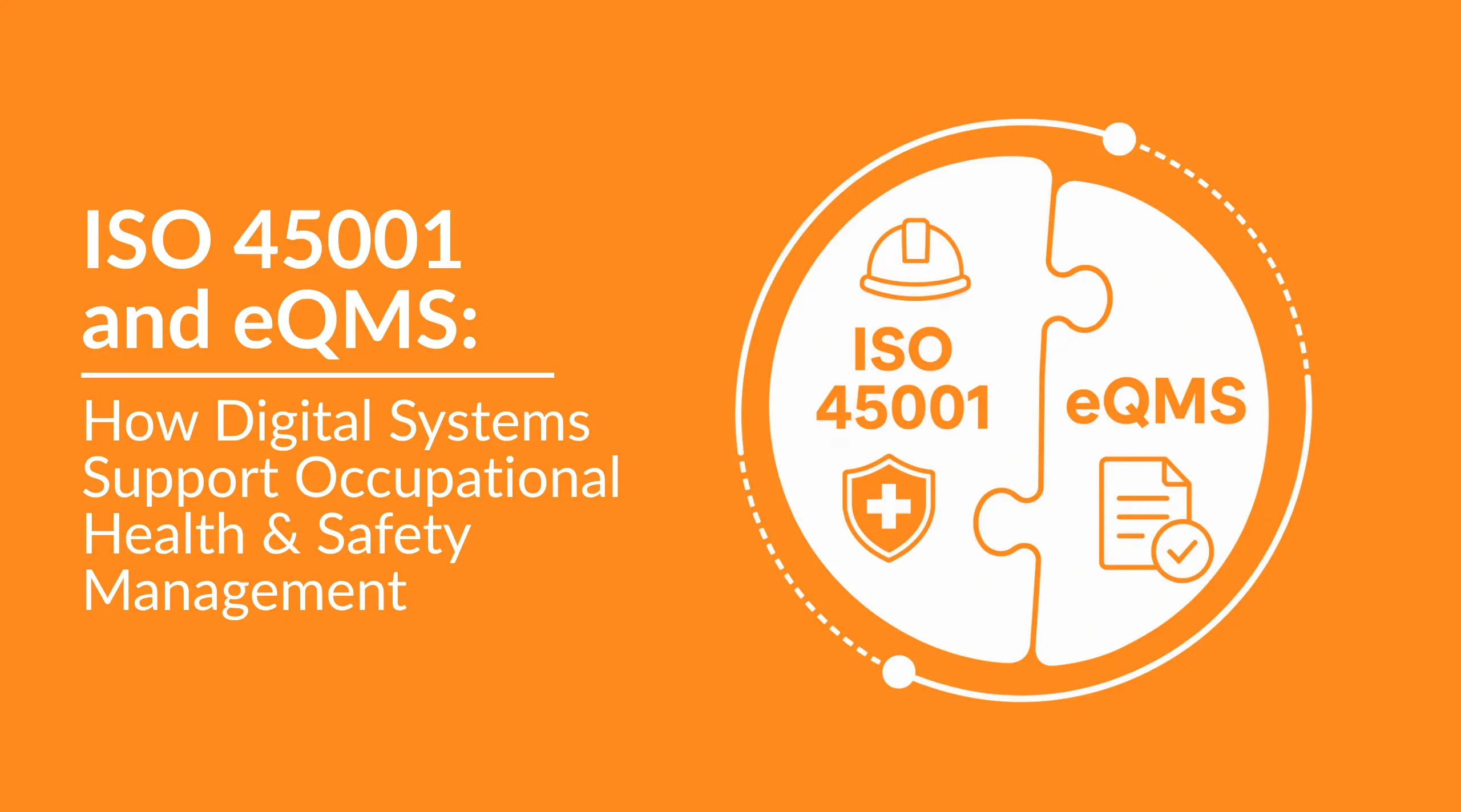
ISO 45001 and eQMS: How Digital Systems Support Occupational Health & Safety Management
Managing occupational health and safety is not limited to identifying hazards or responding when an incident occurs. Organisations need to consistently identify risks, implement controls, maintain relevant documentation, train employees, track actions, conduct audits and review performance. As these activities grow across departments and locations, managing them through spreadsheets, emails, shared folders and physical records can become increasingly difficult.
ISO 45001 provides a structured framework for managing occupational health and safety through a systematic approach to hazards, risks, controls, responsibilities, monitoring and continual improvement. But having a framework is only one part of effective OH&S management. Organisations also need practical systems that help them apply that framework consistently in everyday operations.
This is where an eQMS can support an occupational health and safety management system. By bringing documents, records, risk-related information, actions, workflows and audit evidence into a structured digital environment, an eQMS can improve visibility and traceability across the management system.
So, how does eQMS support ISO 45001? And where does digital management make a difference to day-to-day occupational health and safety activities?
What Is ISO 45001?
ISO 45001 is an international standard for occupational health and safety (OH&S) management systems. It provides a framework that organisations can use to systematically manage workplace health and safety risks and improve OH&S performance.
The standard focuses on areas such as:
- Leadership and worker participation
- Hazard identification and risk assessment
- Operational controls
- Legal and other applicable requirements
- Competence, training and awareness
- Emergency preparedness and response
- Incident investigation
- Monitoring and evaluation
- Internal audits
- Corrective action and continual improvement
The objective is not simply to maintain safety-related documents. An effective OH&S management system needs to connect these activities so that risks are identified, responsibilities are clear, actions are followed up and evidence remains available when required.
Why Digital Systems Matter in ISO 45001 Management
Many organisations begin managing OH&S information using spreadsheets, shared drives, emails and individual departmental records. These methods may work when the amount of information is small. As the organisation grows, however, maintaining consistency becomes more difficult.
Risk assessments may be stored in different spreadsheets. Corrective actions may be followed up through email. Training records may sit with different departments. Documents can have multiple versions, while audit evidence may need to be collected manually.
The problem is not necessarily the absence of information. It is the difficulty of keeping that information structured, current, traceable and accessible.
An eQMS provides a digital environment where relevant management-system information can be organised through defined workflows, controlled access, records, actions and traceability. This allows teams to spend less time searching for information and more time managing the activities themselves.
Manage ISO 45001 Activities Digitally
Bring risk assessments, documents, records, audits, and corrective actions into one structured digital system.
How eQMS Supports ISO 45001 Requirements
An eQMS does not replace an organisation’s OH&S management system or make an organisation ISO 45001 compliant by itself. Instead, it provides the digital infrastructure that can help teams manage many of the activities and evidence associated with the system more consistently.
Hazard Identification and Risk Assessment
Hazard identification and risk assessment are central to occupational health and safety management. Organisations need to identify potential hazards, evaluate associated risks, determine appropriate controls and review information when conditions change.
Managing this information in disconnected spreadsheets can make it difficult to understand the current status of risks and related actions.
A digital risk assessment system can provide a structured way to document hazards and risks, record their causes and potential impacts, evaluate risk levels, associate controls and assign actions to responsible people. It can also help maintain previous versions and provide a clearer history of changes.
This makes risk information easier to review and gives teams better visibility into outstanding actions and changing risk conditions.
Document Control and ISO 45001 Documentation
OH&S management relies on documented information such as policies, procedures, work instructions, forms and other controlled documents.
When these documents are managed manually, outdated copies can remain in shared folders or local systems. Employees may also be unsure about which version is currently approved.
Digital document management helps organisations establish a more controlled process for creating, reviewing, approving, revising and accessing documents. Version history and controlled workflows make it easier to identify the latest approved information and maintain traceability.
For ISO 45001 management, this is particularly useful when procedures or instructions need to be updated following changes in processes, risks, incidents or organisational requirements.
Training and Competence Records
Safety procedures are only effective when employees understand what they are required to do.
Organisations therefore need to manage training and competence-related information and maintain evidence that relevant personnel have received appropriate training.
An eQMS can centralise training information and provide better visibility into training activities, employee records, requirements and follow-up. Instead of relying on individual spreadsheets or manually checking multiple records, teams can manage training information through a structured system.
This supports a more consistent approach to maintaining evidence related to employee competence and awareness.
Incident and Non-Conformance Management
When an incident, non-conformance or other safety-related issue occurs, recording the event is only the beginning. Organisations need to understand what happened, determine appropriate corrective actions, assign responsibility and follow those actions through to closure.
Digital workflows can make this process more structured by keeping the issue, actions, responsibilities, due dates and supporting information connected.
This also helps organisations identify whether similar problems are recurring rather than treating every issue as an isolated event.
Corrective Action and Follow-Up
Corrective actions can easily become difficult to manage when they are tracked through emails, spreadsheets or meeting notes.
An action may have an assigned owner but no clear follow-up mechanism. Another action may remain open because its due date was missed. Over time, these gaps can affect the effectiveness of the OH&S management system.
Digital workflows provide greater visibility into open actions, responsibilities, deadlines and status. Alerts and reminders can also help teams follow up on activities before they become overdue.
The benefit is not simply faster closure. The objective is to make corrective action management more consistent and traceable.
Managing ISO 45001 Records Digitally
Records provide evidence that planned activities have actually been performed. These may include training records, audit records, risk assessment information, corrective action evidence, incident-related records, meeting records and other OH&S documentation.
When records are spread across emails, folders, spreadsheets and physical files, retrieving the right evidence can take significant time.
A digital record management system can provide a centralised approach to storing organising, retrieving and retaining records. With appropriate access controls and traceability, teams can locate information more efficiently while maintaining a clearer history of management-system activities.
This becomes particularly valuable when teams need to demonstrate what was done, when it was done and what happened afterward.
Supporting ISO 45001 Audits with Better Traceability
Audits require evidence, and Auditors may need to review documents, records, risk assessments, training information, corrective actions and other evidence to determine whether the management system is functioning as intended.
If information is stored across multiple locations, preparing for an audit can become a time-consuming exercise in collecting and verifying records.
With an eQMS, relevant information can be maintained within structured workflows and centralised repositories. This improves traceability and makes it easier for teams to locate supporting evidence when required.
More importantly, audit readiness becomes part of routine management rather than an activity that begins only when an audit is approaching.
From Manual OH&S Management to Digital Management
The difference between manual and digital management is not simply about replacing paper with software. It is about creating a more consistent way to manage information and follow processes.
| Manual Approach | Digital Approach |
|---|---|
| Risk assessments maintained in separate spreadsheets | Structured risk and hazard information |
| Documents stored across folders | Controlled document workflows and version history |
| Actions followed up through emails | Assigned actions with status and due-date visibility |
| Records spread across different locations | Centralised record management |
| Audit evidence collected manually | Easier retrieval and traceability |
| Multiple versions of information | Better control over current and previous versions |
| Limited visibility of overdue activities | Alerts, reminders and status tracking |
The advantage becomes more noticeable as the organisation manages more processes, employees, locations, documents and compliance-related activities.
What Should You Look for in an ISO 45001 eQMS?
When evaluating ISO 45001 software, organisations should focus on whether the system can support their actual OH&S workflows not simply how many features it offers. The system should help connect the activities that make up the management system.
Important capabilities include:
- Risk and hazard management: A structured way to identify hazards, assess risks, document controls and track related actions.
- Document control: Version management, review and approval workflows and controlled access to documents.
- Record management: Centralised storage, retrieval and traceability of management-system records.
- Action tracking: Clear ownership, deadlines, status visibility and follow-up.
- Audit support: Better organisation and retrieval of information required for audits.
- Training management: Visibility into training activities and related records.
- Workflow management: Defined processes that reduce dependence on manual follow-up.
- Alerts and reminders: Timely notifications for reviews, actions and other important activities.
- Traceability: A clearer history of activities, changes, approvals and follow-up.
The right combination depends on the organisation’s processes and the areas where manual management currently creates the most difficulty.
How Pyraman Supports Digital OH&S Management
Pyraman provides a digital platform for managing QMS and EHS activities through structured workflows and centralised information. Instead of keeping important quality and safety-related information across disconnected files and systems, organisations can manage relevant activities within one platform.
For occupational health and safety management, Pyraman can support areas such as hazard and risk assessment, document control, records, non-conformances, audits, training, objectives, incidents and other EHS-related activities. This helps teams improve visibility, maintain traceability and follow management-system activities more consistently.
The goal is not to automate ISO 45001 compliance itself. It is to make the underlying management processes easier to control, monitor, document and improve.
Ready to see how digital quality and EHS management can work for your organisation?
Book Your Personalized Pyraman eQMS Demo
Frequently Asked Questions
1. Is ISO 45001 software the same as an eQMS?
Not necessarily. ISO 45001 software may focus specifically on occupational health and safety or EHS processes, while an eQMS can support a broader management system that includes quality and EHS-related activities.
2. How does digital risk assessment support ISO 45001?
Digital risk assessment can help organisation’s structure hazard and risk information, document controls, assign actions, monitor risk status and maintain a traceable history of changes and reviews.
3. What are the benefits of managing ISO 45001 records digitally?
Digital record management can make OH&S records easier to organise, search, retrieve and track. It can also reduce the time required to locate evidence during internal reviews or audits.
See how Pyraman can help you manage documents, records, risks, actions, audits, training and other management-system activities through one digital platform.
3. How does an eQMS help with ISO 45001?
An eQMS helps organisations manage ISO 45001-related activities in a structured digital environment. It can connect risk assessments, controlled documents, records, audits, corrective actions, training and follow-up activities, giving teams better visibility and traceability across the OH&S management system.
4. What should I consider when choosing an eQMS for ISO 45001?
Look at whether the software can support your actual OH&S workflows, including risk assessment, document and record management, corrective actions, audits, training, traceability and follow-up. It is also important to consider usability, workflow flexibility, access control, reporting visibility and how easily the system can fit into your existing management processes.
5. Can an eQMS replace Excel for ISO 45001 management?
Yes. An eQMS can replace spreadsheets for many recurring ISO 45001 management activities by providing structured workflows, controlled information, assigned actions, status tracking and centralised records. This becomes particularly useful when multiple people or departments need to work with the same information.

Start Your Free 30-Day eQMS Trial
Get full access to Pyraman eQMS for 30 days, free. No commitment, just hands-on document control, audits, and compliance management.
