
How to Reduce the Cost of Poor Quality (COPQ) in Manufacturing
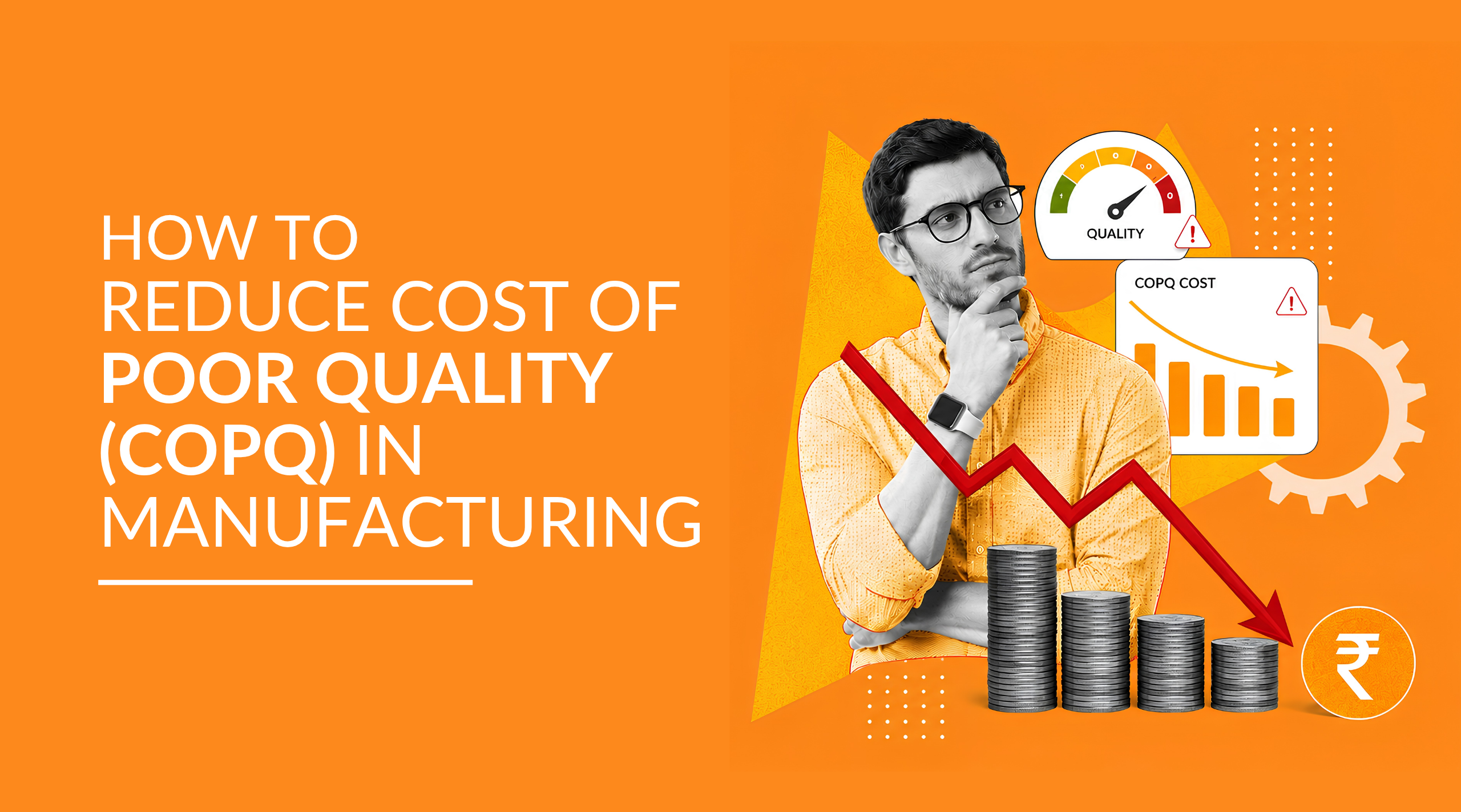
Manufacturers today operate in a highly competitive environment where every production decision affects profitability. While many focus on reducing material costs or improving production efficiency, one of the biggest hidden expenses is the cost of poor quality in manufacturing.
Every defective product, production delay, customer complaint or warranty claim increases avoidable costs. Beyond financial losses, poor quality impacts operational efficiency, customer satisfaction and regulatory compliance.
Industry studies estimate that the Cost of Poor Quality (COPQ) can account for 15% to 20% of annual sales revenue. However, many manufacturers only measure visible costs like scrap and rework, overlooking hidden losses such as delayed deliveries, lost customers and reputational damage.
Reducing COPQ requires more than correcting defects after they occur. It demands a proactive approach that combines standardized quality processes, continuous improvement and digital quality management to prevent issues before they impact production or customers.
What Is the Cost of Poor Quality (COPQ)?
The Cost of Poor Quality (COPQ) is the total cost a business incurs due to defects, errors and process failures that result in products or services not meeting quality standards. It includes expenses such as scrap, rework, warranty claims, product returns, customer complaints and recalls. These costs are avoidable and can be significantly reduced through effective quality management practices
| Internal Failure Costs | Business Impact | External Failure Costs | Business Impact |
|---|---|---|---|
| Scrap & material waste | Increases material costs and reduces profitability | Customer complaints | Lowers customer satisfaction and damages brand reputation |
| Product rework | Increases labour costs and delays production | Product returns | Raises replacement and reverse logistics costs |
| Retesting and reinspection | Consumes additional time and quality resources | Warranty claims/replacements | Increases after-sales service and warranty expenses |
| Machine downtime | Reduces production efficiency and output | Product recalls | Leads to significant financial losses and regulatory risks |
| Production delays | Impacts delivery schedules and customer commitments | Field service and repair | Increases service costs and resource utilization |
| Additional labour costs | Raises operational expenses | Legal liabilities | Can result in financial penalties and legal expenses |
| Yield losses | Reduces production efficiency and overall profitability | Lost customer trust and brand reputation | Impacts customer retention, future sales and long-term business growth |
In manufacturing, COPQ represents the financial impact of poor quality across the entire production lifecycle from raw material inspection and production to product delivery and after-sales service. While some costs, such as scrap and rework, are easy to measure, others, including lost customers, reputational damage and compliance issues, often remain hidden but can have a much greater long-term impact.
COPQ is broadly classified into two categories based on when the quality failure is identified.
Categories of the Cost of Poor Quality (COPQ)
These costs occur when quality issues are discovered either during production or after products reach customers. They are generally divided into two categories:
How to Calculate the Cost of Poor Quality (COPQ)
Many manufacturers underestimate the cost of poor quality in manufacturing by focusing only on visible expenses such as scrap and rework. However, the true financial impact also includes warranty claims, customer complaints, production downtime and other hidden costs.
Calculating COPQ helps organizations understand where quality failures occur, quantify their financial impact and prioritize improvement initiatives that deliver the greatest return.
COPQ Formula
The standard formula for calculating the Cost of Poor Quality is:
Cost of Poor Quality (COPQ) = Internal Failure Costs + External Failure Costs
Manufacturing Example
Consider a manufacturer producing industrial valves. During a single month, the company records the following quality-related costs:
| Category | Quality Issue | Cost |
|---|---|---|
| Internal Failure Cost | Scrap materials | ₹3,20,000 |
| Internal Failure Cost | Rework | ₹1,80,000 |
| Internal Failure Cost | Additional inspections | ₹60,000 |
| Internal Failure Cost | Production downtime | ₹2,40,000 |
| External Failure Cost | Warranty replacements | ₹2,10,000 |
| External Failure Cost | Customer returns | ₹90,000 |
| External Failure Cost | Complaint investigations | ₹50,000 |
Total Internal Failure Cost: ₹8,00,000
Total External Failure Cost: ₹3,50,000
Total Cost of Poor Quality (COPQ): ₹11,50,000
Now imagine reducing recurring defects by just 25% through process improvements and digital quality management. The manufacturer could save nearly ₹2.9 lakh every month, while also improving production efficiency, customer satisfaction and overall profitability.
This example highlights that measuring COPQ is more than a financial calculation it’s a practical way to identify improvement opportunities, reduce avoidable costs and strengthen long-term manufacturing performance.
Common Causes of High Cost of Poor Quality in Manufacturing
Recurring quality issues are rarely isolated incidents. In most cases, they stem from underlying process gaps that, if left unaddressed, continue to increase the cost of poor quality in manufacturing. Identifying these root causes is the first step toward preventing defects and reducing quality-related costs.
1. Inconsistent Production Processes
Variations in work methods, outdated instructions and non-standardized procedures often result in inconsistent product quality across shifts or production lines. Standardizing the quality process in manufacturing helps minimize variation, improve consistency and reduce defects.
2. Manual Quality Inspections
Paper-based inspections and manual data entry are prone to human error, delayed reporting and limited traceability. Digital inspections provide real-time visibility into quality performance, enabling faster and more accurate corrective actions.
3. Poor Document Control
Using outdated work instructions, specifications or standard operating procedures can lead to production errors and compliance issues. Centralized document control ensures employees always have access to the latest approved documents, reducing the risk of avoidable mistakes.
4. Delayed Corrective and Preventive Actions (CAPA)
When corrective actions are delayed or root causes are not fully addressed, the same quality issues continue to recur. An effective CAPA process helps eliminate the source of defects rather than repeatedly fixing their symptoms.
5. Supplier Quality Issues
Defective raw materials or components can introduce quality problems before production even begins. Regular supplier evaluations, incoming inspections and supplier performance monitoring help reduce scrap, rework, production delays and customer complaints.
6. Lack of Real-Time Quality Data
Relying on spreadsheets or disconnected systems makes it difficult to identify trends and respond quickly to quality issues. An integrated quality management software for manufacturing provides centralized data, automated workflows and real-time insights, enabling manufacturers to detect risks early and reduce the overall cost of poor quality.
Reduce Quality Costs. Improve Manufacturing Performance.
Book a Free Demo with Pyraman now.
How Quality Management Software Helps Reduce the Cost of Poor Quality
Reducing the cost of poor quality in manufacturing requires more than identifying defects after they occur. Manufacturers need a proactive approach that standardizes quality processes, automates workflows and provides real-time visibility into quality performance.
A modern quality management software for manufacturing connects every stage of the quality lifecycle from inspections and non-conformance management to CAPA, supplier quality and complaint handling helping organizations prevent defects, improve compliance and reduce quality-related costs.
Here’s how it helps reduce COPQ.
1. Automate Non-Conformance Management
Non-conformances are inevitable in manufacturing, but how quickly they’re identified and resolved determines their impact on quality costs. When managed through spreadsheets or paper-based records, reporting delays and inconsistent investigations often allow the same issues to recur, resulting in increased scrap, rework and production downtime.
Quality management software automates the entire non-conformance process by capturing issues in real time, assigning investigations automatically and tracking every action until closure. With a centralized system, manufacturers gain complete visibility into non-conformances, making it easier to identify trends and prevent repeat failures.
Benefits of automated non-conformance management:
- Capture and report quality issues in real time
- Standardize investigations and approval workflows
- Reduce scrap, rework and production downtime
- Maintain complete traceability with audit trails
- Prevent recurring defects through timely resolution
2. Strengthen CAPA Workflows
Corrective and Preventive Action (CAPA) is one of the most effective tools for reducing the cost of poor quality in manufacturing. However, when CAPA activities are managed manually, investigations are often delayed, actions are missed and recurring issues remain unresolved.
Quality management software streamlines the entire CAPA lifecycle by guiding teams through root cause analysis, action planning, implementation and effectiveness verification. Automated reminders, approvals and progress tracking ensure corrective actions are completed on time and permanently eliminate the source of quality issues.
A digital CAPA workflow helps manufacturers:
- Perform structured root cause analysis
- Assign ownership and due dates automatically
- Track corrective actions from initiation to closure
- Verify CAPA effectiveness before closing cases
- Eliminate recurring defects and improve process reliability
3. Digitize Quality Inspections
Manual inspections often result in incomplete records, delayed reporting and inconsistent inspection practices across production lines. These gaps make it difficult to detect quality issues early, increasing the risk of defective products reaching the next stage of production or the customer.
Digital inspection workflows standardize inspection processes and enable quality teams to record findings instantly using mobile devices or tablets. Real-time reporting allows supervisors to respond immediately to deviations, preventing minor issues from becoming costly failures.
Digital quality inspections enable manufacturers to:
- Standardize inspection procedures across facilities
- Capture inspection results instantly
- Identify quality deviations earlier
- Reduce manual data entry and reporting errors
- Improve product consistency and traceability
4. Centralize Document Control
Using outdated work instructions, specifications or Standard Operating Procedures (SOPs) is a common cause of manufacturing defects and compliance issues. When employees cannot easily access the latest approved documents, process variation and human error become more likely.
Quality management software centralizes document control by maintaining a single repository for all quality documents, with version control, approval workflows and access permissions. This ensures employees always work with the most up-to-date information while simplifying audit preparation and regulatory compliance.
Centralized document control helps organizations:
- Eliminate obsolete or uncontrolled documents
- Ensure employees access the latest approved versions
- Simplify document review and approval workflows
- Maintain complete version history and audit trails
- Improve compliance with industry standards
5. Improve Supplier Quality Management
Supplier-related quality issues often become internal manufacturing problems, increasing inspection costs, production delays and customer complaints. Without a structured process for monitoring supplier performance, recurring defects can continue unnoticed.
Quality management software provides a centralized platform to evaluate supplier performance, record supplier non-conformances, manage supplier audits and track corrective actions. This enables manufacturers to identify underperforming suppliers early and collaborate more effectively to improve incoming material quality.
Effective supplier quality management helps:
- Reduce incoming material defects
- Monitor supplier performance continuously
- Manage supplier corrective actions efficiently
- Improve supplier accountability
- Build a more reliable and resilient supply chain
6. Manage Customer Complaints Efficiently
Customer complaints often reveal underlying quality issues that internal inspections may not detect. If complaints are handled manually, investigations become slower, communication gaps increase and recurring issues remain unresolved, leading to higher warranty costs and reduced customer trust.
Quality management software centralizes complaint management by linking complaints with production records, inspections, non-conformances and CAPAs. This allows quality teams to investigate issues faster, identify root causes and implement corrective actions that prevent similar complaints in the future.
An integrated complaint management system helps manufacturers:
- Respond to customer complaints faster
- Improve product traceability
- Link complaints directly to CAPA and investigations
- Reduce warranty claims and product returns
- Improve customer satisfaction and retention
7. Monitor Quality KPIs with Real-Time Dashboards
Without accurate and timely quality data, manufacturers often make decisions based on assumptions rather than facts. This reactive approach allows quality issues to grow before corrective actions are taken, increasing the overall Cost of Poor Quality.
Quality management software provides real-time dashboards that consolidate quality data from inspections, audits, CAPAs, supplier performance and customer complaints into a single view. Management teams can monitor trends, identify risks early and make informed decisions to improve quality performance.
Track important quality metrics such as:
- Defect rate
- Scrap and rework costs
- First Pass Yield (FPY)
- Customer complaint trends
- CAPA status
- Supplier quality performance
- Audit findings and compliance status
8. Analyse Quality Trends to Prevent Recurring Defects
Every quality event generates valuable data, but without proper analysis, recurring issues often remain hidden. Simply resolving individual defects does not prevent future failures or reduce long-term quality costs.
Quality management software consolidates data from inspections, audits, complaints, CAPAs and non-conformances to identify recurring patterns and process weaknesses. These insights help manufacturers implement preventive actions, optimize processes and continuously improve product quality.
Trend analysis enables manufacturers to:
- Identify recurring defects and process bottlenecks
- Prioritize improvement initiatives using quality data
- Make proactive, data-driven decisions
- Support continuous improvement programs
- Reduce the Cost of Poor Quality over the long term
Reduce Quality Costs with Pyraman eQMS
Improving quality isn’t just about fixing today’s issues it’s about preventing tomorrows.
Pyraman eQMS provides manufacturers with a centralized platform to streamline quality processes, improve traceability and reduce the cost of poor quality in manufacturing. By automating critical quality workflows and providing real-time visibility, it helps quality teams identify issues earlier, respond faster and drive continuous improvement across the organization.
With Pyraman eQMS, manufacturers can:
- Centralize quality processes on a single platform
- Automate CAPA and non-conformance workflows
- Digitize inspections and quality checklists
- Simplify document and change control
- Strengthen supplier quality management
- Track customer complaints from reporting to resolution
- Monitor quality performance with real-time dashboards and analytics
- Maintain audit readiness with complete traceability
By replacing manual processes with a connected quality management system in manufacturing, organizations can reduce recurring defects, improve operational efficiency and make faster, data-driven quality decisions.
Ready to reduce quality costs and improve manufacturing performance?
Book a personalize demo with Pyraman eQMS and see how digital quality management can help your organization minimize COPQ while improving compliance, productivity and customer satisfaction.
Frequently Asked Questions (FAQs)
1. What is the Cost of Poor Quality (COPQ)?
The Cost of Poor Quality (COPQ) refers to the expenses incurred when products or processes fail to meet quality standards. These costs include scrap, rework, warranty claims, customer complaints, recalls and other losses resulting from quality failures.
2. How do you calculate the Cost of Poor Quality?
The basic formula is:
COPQ = Internal Failure Costs + External Failure Costs
Internal failure costs include scrap, rework and production downtime, while external failure costs include warranty claims, customer returns, recalls and complaint handling.
3. What are the four categories of quality costs?
Quality costs are generally classified into four categories:
- Prevention Costs
- Appraisal Costs
- Internal Failure Costs
- External Failure Costs
The first two contribute to the Cost of Good Quality, while the latter two make up the Cost of Poor Quality.
4. Why is COPQ important in manufacturing?
Measuring COPQ helps manufacturers identify hidden quality-related expenses, improve operational efficiency, reduce waste and increase profitability through better quality management.
5. How can manufacturers reduce the Cost of Poor Quality?
Manufacturers can reduce COPQ by:
- Standardizing quality processes
- Strengthening supplier quality management
- Performing root cause analysis
- Implementing effective CAPA
- Monitoring quality KPIs
- Digitizing quality workflows
- Continuously improving manufacturing processes
6. Which industries benefit most from reducing COPQ?
Industries with strict quality and regulatory requirements gain significant value from reducing COPQ, including:
- Automotive
- Aerospace
- Pharmaceuticals
- Medical Devices
- Food & Beverage
- Electronics
- Industrial Manufacturing
By improving quality processes and reducing defects, these industries can enhance compliance, customer satisfaction and overall operational performance.

More than Thoughts.
More than a Free Trial.
Register yourselves for a digital experience that makes operational excellence attainable.
