
Risk-Based Quality Management: How to Prioritise Quality Issues by Impact and Severity
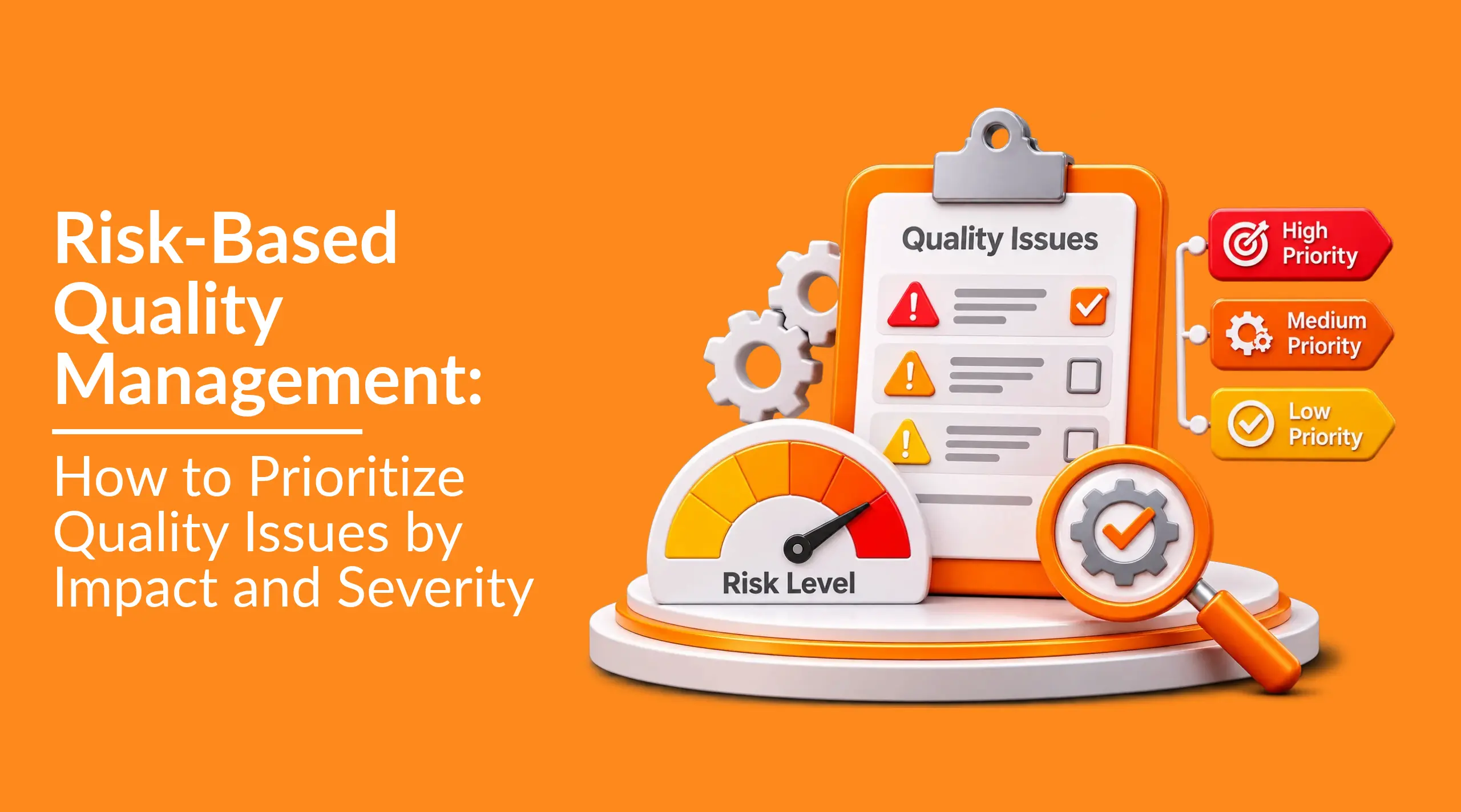
Not every quality issue creates the same level of risk for an organisation. A minor documentation error, a recurring production defect and a customer complaint involving product safety may all require attention, but they do not necessarily demand the same level of urgency or resources.
When quality teams treat every issue with equal priority, critical problems can remain unresolved while time and resources are spent addressing less significant concerns. This can delay corrective actions, increase operational disruptions and affect customer satisfaction.
Risk-based quality management helps organisations make more informed decisions by evaluating quality issues according to their potential impact, severity and likelihood of occurrence. Instead of responding to problems only in the order they are reported, quality teams can focus on issues that pose the greatest threat to product conformity, process performance and customer requirements.
In this blog, we will explore how organisations can prioritise quality issues using a risk-based approach and how this supports more effective quality management.
What Is Risk-Based Quality Management?
Risk-based quality management is an approach that uses risk assessment to determine which quality issues require the most attention. It considers the potential consequences of an issue, how likely it is to occur and how significantly it could affect products, processes, customers or compliance requirements.
Rather than treating every nonconformance or quality concern equally, organisations evaluate the level of risk associated with each issue and determine appropriate actions.
For example, a missing signature on an internal record may require a documentation correction, while a recurring product defect that could affect customer safety may require immediate investigation and containment. The purpose is not to eliminate every possible risk. It is to ensure that quality decisions, resources and corrective actions are proportionate to the potential consequences of identified issues.
Why Is Prioritising Quality Issues Important?
Quality teams often deal with multiple issues across production, inspection, documentation, audits and customer feedback. Without a defined prioritisation approach, deciding which issue to address first can become difficult.
Prioritising quality issues helps organisations:
- Focus on critical problems: Identify issues that could significantly affect product conformity, customer satisfaction or regulatory requirements.
- Allocate resources effectively: Direct investigation efforts and corrective actions towards problems with greater potential consequences.
- Reduce recurring quality failures: Give appropriate attention to repeated issues that may indicate weaknesses in existing processes.
- Improve response time: Establish clearer priorities for investigation, containment and corrective action.
- Support informed decisions: Provide quality teams and management with a consistent basis for evaluating issues.
A structured prioritisation approach helps organisations move beyond reacting to the number of reported issues and focus on their actual significance.
Key Factors to Consider When Prioritising Quality Issues
To prioritise quality issues effectively, organisations should evaluate more than the number of defects or non-conformances reported. The following factors can help determine the level of attention each issue requires.
1. Severity of the Issue
Severity refers to how serious the consequences could be if a quality issue remains unresolved. For example, a minor labelling error that does not affect product identification may have limited consequences. In contrast, a defect that affects product safety, performance or essential customer requirements may represent a critical concern.
When assessing severity, quality teams should consider:
- Potential impact on product safety and functionality.
- Failure to meet customer specifications.
- Possible regulatory or contractual consequences.
- Effect on product conformity and reliability.
- Potential damage to customer confidence.
Issues with serious consequences should receive greater attention, even if they occur infrequently.
2. Impact on Operations and Customers
Impact evaluates how significantly a quality issue could affect business operations and external stakeholders. A problem may appear limited within one department but create wider consequences if it affects production schedules, delivery commitments, customer requirements or other processes.
For example, an incorrect inspection method may result in defective products passing through quality checks. If the same method is used across multiple production activities, the potential impact could extend beyond a single batch.
Organisations should assess whether an issue could affect:
- Production continuity and delivery schedules.
- Product acceptance and customer satisfaction.
- Material consumption and operational costs.
- Downstream processes and other departments.
- Compliance obligations and audit outcomes.
Understanding the wider impact helps teams avoid underestimating issues that may initially appear isolated.
3. Likelihood of Occurrence
Likelihood refers to how probable it is that a quality issue will occur or happen again. It focuses on the possibility of future occurrence based on process conditions, existing controls and previous quality data.
For example, if a manufacturing process has inadequate controls to maintain dimensional accuracy, there may be a higher likelihood of similar defects occurring in future production batches.
Quality teams can evaluate likelihood by reviewing:
- Previous non-conformance records.
- Historical inspection and testing results.
- Existing process controls and their effectiveness.
- Customer complaint trends.
- Process deviations and known failure patterns.
Assessing likelihood helps organisations estimate the possibility of an issue occurring again and determine whether additional preventive measures are needed.
4. Frequency and Recurrence
Frequency refers to how often a quality issue has actually occurred within a defined period. Unlike likelihood, which considers the possibility of future occurrence, frequency focuses on the issue’s observed history.
For example, if dimensional defects have been reported in five out of the last six production batches, the issue has a high frequency and may indicate an ongoing process weakness.
Quality teams should examine:
- How many times the issue has been reported.
- Whether it occurs across multiple production batches or processes.
- Whether similar issues have appeared in previous audits or inspections.
- Whether corrective actions have reduced the number of repeated occurrences.
Reviewing frequency helps organisations identify recurring quality problems, understand their patterns and determine whether existing corrective actions have been effective.
How to Prioritise Quality Issues Using a Risk-Based Approach
Once the relevant factors have been identified, organisations can follow a structured approach to evaluate and prioritise quality issues.
Step 1: Identify and Document Quality Issues
The first step is to establish a clear record of identified quality issues.
These may originate from:
- Internal inspections and testing.
- Manufacturing process deviations.
- Internal and external audits.
- Customer complaints and feedback.
- Document and record control activities.
- Non-conformance reports.
Each issue should include sufficient information to understand what happened, where it occurred, the affected process or product and the potential consequences. Accurate documentation provides the foundation for consistent evaluation and follow-up.
Step 2: Assess Severity and Potential Impact
Evaluate how serious the consequences could be if the issue is not addressed. Consider its effect on product conformity, customer requirements, operational continuity and applicable compliance obligations.
For instance, an issue affecting a critical product characteristic should generally receive greater attention than a minor administrative error with no significant effect on product conformity. The assessment should reflect the organisation’s products, processes, customer expectations and applicable requirements.
Step 3: Evaluate Likelihood and Recurrence
Next, determine how likely the issue is to occur again. Review previous incidents, inspection records, complaints and other relevant quality information. A recurring issue may indicate that existing controls are insufficient or that previous corrective actions have not addressed the underlying cause. Combining likelihood with severity and impact provides a more complete understanding of the issue.
Step 4: Assign a Risk Priority
After evaluating the relevant factors, classify issues according to their overall priority. An organisation may use a simple risk matrix to group issues into categories such as low, medium and high risk.
The following is an illustrative example:
| Risk level | Typical characteristics | Suggested response |
|---|---|---|
| High | Serious potential consequences, significant customer impact or recurring critical failures. | Immediate attention, appropriate containment and prioritised investigation. |
| Medium | Noticeable process or product impact, or issues with a reasonable likelihood of recurrence. | Planned investigation, corrective action and regular follow-up. |
| Low | Limited consequences with no significant effect on product conformity or customer requirements. | Routine correction, monitoring and documented follow-up. |
The organisation should define its own assessment criteria and escalation thresholds. A low-frequency issue should not automatically receive a low priority if its potential consequences are severe.
Using FMEA for Quality Risk Assessment
Failure Mode and Effects Analysis (FMEA) is a structured method used by organisations to identify potential failure modes, evaluate their possible effects and determine which risks require attention.
FMEA generally assesses three factors:
- Severity: How serious would the consequences of the failure be?
- Occurrence: How likely is the failure to happen?
- Detection: How likely is the failure to go undetected before it reaches the next process or customer?
These factors are commonly rated using numerical scales and may be combined to calculate a Risk Priority Number (RPN). This helps teams compare potential failure modes and identify areas that may require further investigation or preventive action.
FMEA can support risk-based quality management by providing a systematic way to evaluate potential failures. However, organisations should not rely on the RPN alone. A failure with severe consequences may still require immediate attention even if its overall score is relatively low.
Step 5: Assign Responsibility and Take Appropriate Action
Once priorities are established, assign responsibility for investigation and resolution. High-priority issues may require immediate containment, management involvement and faster investigation. Medium- and low-priority issues can be addressed according to their defined timelines and organisational procedures. Responsibilities should be clear, including who will investigate the issue, implement corrective actions and monitor progress.
Step 6: Review Outcomes and Reassess Risk
Prioritisation should not end once an action has been assigned. Organisations should review whether the issue has been adequately addressed and whether the actions taken have reduced the likelihood or consequences of recurrence. If similar problems continue to appear, the original assessment may need to be revisited. Changes in customer requirements, production processes or operating conditions may also affect the priority of previously identified issues. Regular reassessment helps ensure that quality priorities remain relevant.
Practical Example: Prioritising Quality Issues in Manufacturing
Consider a manufacturing company that identifies three quality issues during its monthly review:
| Identified issue | Potential impact | Recurrence | Priority |
|---|---|---|---|
| Missing approval signature on an internal record. | Limited documentation concern. | Occasional | Low |
| Repeated dimensional defects in a production batch. | Product conformity and rework concerns. | Frequent | High |
| Delay in updating a non-critical internal procedure. | Limited process documentation impact. | Occasional | Medium to Low |
The repeated dimensional defect receives the highest priority because it directly affects product conformity and has occurred frequently.
The missing signature and delayed procedure update still require appropriate correction, but their limited impact does not necessarily require the same immediate attention or resources as the recurring production defect.
This example demonstrates why the number of reported issues alone should not determine priorities. Their potential consequences and likelihood of recurrence must also be considered.
Common Mistakes in Quality Issue Prioritisation
Even when organisations have defined quality procedures, prioritisation can become inconsistent if assessments rely on assumptions or incomplete information.
Some common mistakes include:
- Treating Every Issue Equally: Assigning the same urgency to every non-conformance makes it difficult to distinguish critical problems from routine corrections.
- Focusing Only on Frequency: A frequently occurring issue may require attention, but a rare issue with severe potential consequences should not be overlooked.
- Ignoring Customer and Compliance Impact: An issue that appears minor internally may have serious consequences for customer acceptance or applicable requirements.
- Using Inconsistent Assessment Criteria: If different departments use different definitions of severity and priority, similar issues may receive different levels of attention.
- Closing Issues Without Reviewing Their Effectiveness: Completing corrective actions does not automatically mean the underlying problem has been resolved. Organisations should review whether the issue has recurred and whether the actions taken have addressed its cause.
How eQMS Software Supports Risk-Based Quality Management
As the number of quality issues increases, managing their records, investigations and follow-up activities through disconnected spreadsheets and emails can become difficult. An eQMS helps organisations bring important quality processes into a more structured digital environment.
Depending on the modules available, an eQMS can support risk-based quality management through:
- Non-conformance Management: Record identified quality issues, document investigations and track corrective actions through defined workflows.
- Audit Management: Maintain audit records, document findings and support follow-up on identified gaps.
- Complaint Management: Record customer complaints and maintain visibility into their investigation and resolution.
- Document Management: Maintain controlled procedures, work instructions and other quality-related documents.
- Record Management: Keep quality records organised and accessible for review and traceability.
These capabilities help teams maintain better control over quality-related information and follow-up activities. However, the organisation remains responsible for defining its risk assessment criteria, evaluating issue severity and determining appropriate priorities.
How Pyraman Supports Structured Quality Management
Pyraman is a cloud-based eQMS platform designed to help organisations manage essential quality processes through dedicated modules.
Its NC Management module supports the recording and tracking of non-conformances and related corrective actions. Audit Management helps teams maintain audit-related records and follow up on findings, while Document Management and Record Management support-controlled documentation and organised quality records.
By bringing these activities into a centralised quality management platform, Pyraman helps organisations maintain visibility over identified issues and the actions taken to address them.
Looking to bring more structure to your quality management processes? Book a free personalised demo of Pyraman and see how its eQMS modules can support your organisation.
Frequently Asked Questions
1. What is the difference between risk-based quality management and traditional quality management?
Traditional quality management may focus heavily on identifying and correcting quality problems after they occur. Risk-based quality management gives additional attention to evaluating potential consequences and likelihood so organisations can prioritise actions according to their significance.
2. How do you assess the severity of a quality issue?
Severity can be assessed by considering the potential consequences for product safety, product conformity, customer requirements, regulatory obligations and operational performance. Organisations should establish defined criteria to ensure consistent evaluations.
3. What is a quality risk matrix?
A quality risk matrix is a tool used to classify risks based on selected assessment factors, commonly including severity and likelihood. It helps organisations group issues into priority levels and determine appropriate responses.
4. Should low-frequency quality issues always receive a low priority?
No. An issue that occurs rarely may still require immediate attention if its potential consequences are severe. Priority should consider both the likelihood of occurrence and the seriousness of the impact.
5. How often should quality risks be reviewed?
Quality risks should be reviewed at intervals defined by the organisation and whenever significant changes occur, such as recurring non-conformances, customer complaints, process changes or new compliance requirements.
6. How does ISO 9001 relate to risk-based quality management?
ISO 9001 incorporates risk-based thinking into the Quality Management System. Organisations are expected to consider risks and opportunities that could affect the intended results of their QMS and plan proportionate actions to address them.



Start Your Free 30-Day eQMS Trial
Get full access to Pyraman eQMS for 30 days, free. No commitment, just hands-on document control, audits, and compliance management.
