
Training Effectiveness vs. Training Completion: Are Employees Following SOPs?
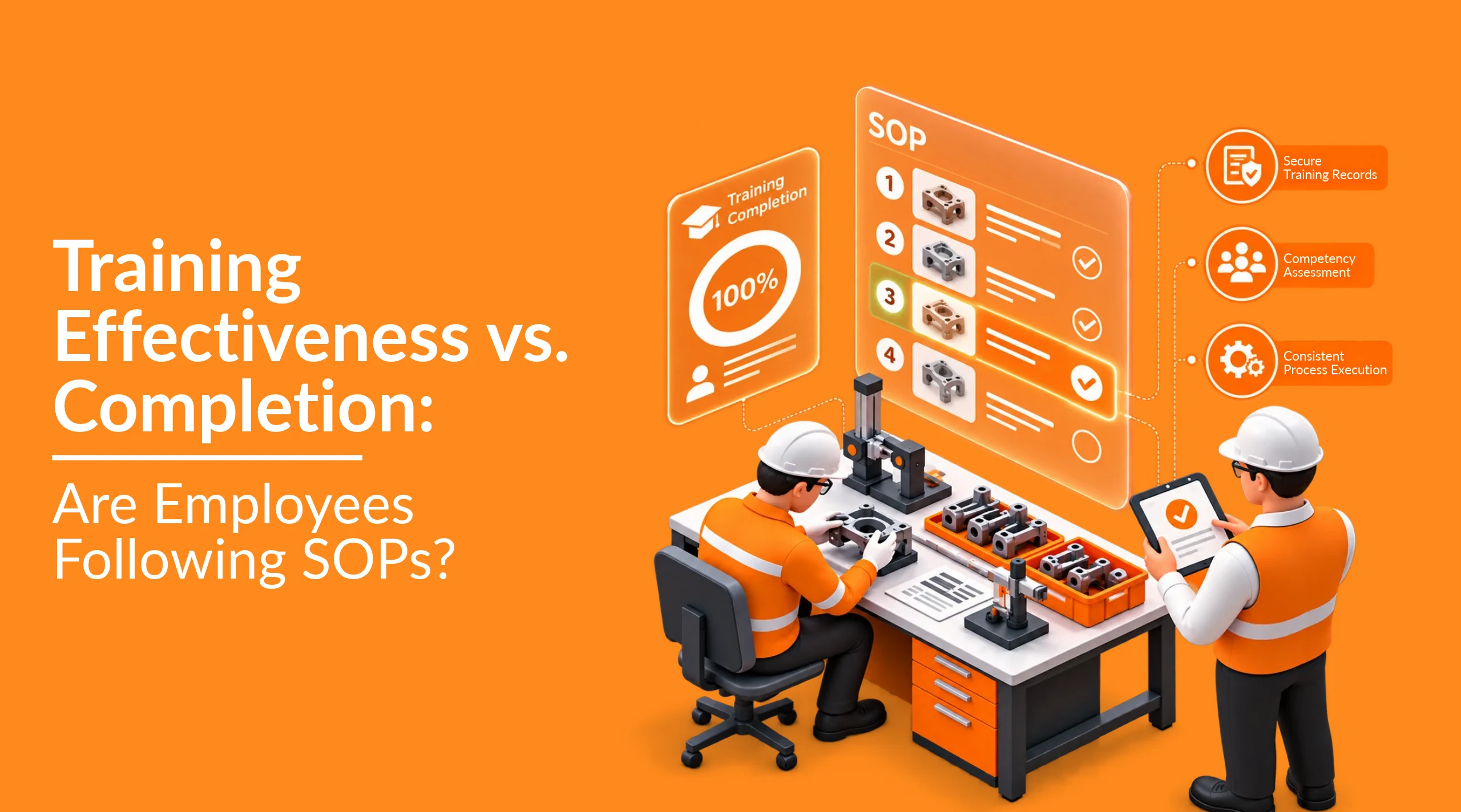
Completing a training session does not always mean an employee can perform a task correctly. An employee may attend a session, acknowledge a procedure and complete the required training record, yet still struggle to apply those instructions during actual work.
This is where the difference between training completion and training effectiveness becomes important. Organisations need to look beyond attendance records and understand whether employees have actually learned what they need to know.
For organisations working with documented procedures and quality management requirements, this distinction matters. Employees must not only receive the right training but also demonstrate that they understand and can follow the procedures relevant to their roles.
Training Completion vs. Training Effectiveness: What Is the Difference?
Training completion confirms that an employee has attended or completed an assigned training activity. It is generally measured through attendance, completion status, acknowledgements or training records.
Training effectiveness goes a step further. It evaluates whether the employee has understood the information, developed the required knowledge or skills and can apply them correctly in their work.
For example, an employee may complete training on a standard operating procedure (SOP). The training record confirms that the session is complete. However, observing the employee perform the task helps determine whether they can actually follow the procedure.
| Training Completion | Training Effectiveness |
|---|---|
| Confirms that an employee has completed assigned training. | Evaluates whether the employee has achieved the intended learning outcomes. |
| Focuses on attendance and completion status. | Focuses on knowledge, understanding and practical application. |
| Tracks whether training activities are completed on time. | Assesses whether employees can perform tasks as required. |
| Relies on attendance sheets, acknowledgements and completion records. | Uses assessments, practical demonstrations and workplace observations. |
| Shows which employees have received training. | Identifies whether employees have developed the required competency. |
| Measures training participation. | Evaluates changes in employee behaviour and work performance. |
| Helps monitor pending and completed training activities. | Helps identify learning gaps and the need for additional training. |
Both are important, but they serve different purposes. Training completion helps organisations track whether employees have received the required training, while training effectiveness helps determine whether that training has translated into the knowledge and skills needed to perform their responsibilities.
Why Training Completion Does Not Always Mean Training Is Effective
A completed training record provides evidence that an employee received the required training. However, it does not automatically demonstrate that the employee understood the procedure or can apply it correctly.
Several factors can affect training effectiveness:
- Limited understanding: Employees may complete a session without fully understanding the instructions or requirements.
- Lack of practical application: Some procedures require hands-on experience. Simply reading a document or attending a presentation may not be enough.
- Outdated knowledge: When procedures, equipment or work requirements change, employees may continue following instructions they learned earlier.
- Different learning needs: Employees may understand information at different rates and require different levels of guidance.
- No follow-up assessment: Without checking performance after training, organisations may not identify whether employees need additional support.
The result is a gap between training completion and actual workplace competency. Identifying this gap requires organisations to evaluate what employees can do, rather than relying only on what training they have attended.
How to Measure Training Effectiveness in the Workplace
Training effectiveness should be evaluated against the knowledge and skills employees are expected to demonstrate after completing a training activity. The assessment method may vary depending on the role, complexity of the task and importance of the procedure.
Here are five practical ways organisations can evaluate whether training has achieved its purpose.
1. Test Understanding After Training
A short assessment or knowledge test can help determine whether employees have understood the key points covered during training.
Practical Example: Comparing Pre-Training and Post-Training Results
Consider an organisation conducting training on its standard operating procedures (SOPs). Before the session, employees complete a short assessment to evaluate their existing understanding of the procedure. After the training, they take another assessment covering the same key requirements.
For example, if an employee scores 60% before training and 90% after training, the improvement indicates better understanding of the procedure.
The improvement can be calculated using the following formula:
Training Score Improvement = Post-Training Score − Pre-Training Score
In this example:
90% − 60% = An improvement of 30 percentage points.
However, a higher assessment score alone does not confirm that the employee can follow the procedure correctly. Workplace observation or a practical competency assessment can provide further evidence of how well the employee applies the learning in actual work.
2. Observe Employees Performing Actual Tasks
One of the most practical ways to evaluate training effectiveness is to observe employees while they perform their assigned activities.
For example, after training on an inspection procedure, a supervisor can observe whether an employee follows the required inspection steps and records the results correctly. This helps identify the difference between knowing what a procedure says and applying it correctly in practice.
3. Evaluate Practical Competency
Some roles require employees to demonstrate specific technical or job-related skills. In such cases, practical assessments can help determine whether employees have developed the required competency.
An organisation can evaluate employees against defined criteria, such as their ability to operate equipment, follow work instructions or complete a task according to established requirements. The assessment should be relevant to the employee’s responsibilities rather than based only on general training attendance.
4. Monitor Work Performance After Training
Training effectiveness can also be evaluated by reviewing employee performance over time.
Organisations can look for indicators such as:
- Repeated errors while performing assigned tasks.
- Deviations from approved procedures.
- Incorrect or incomplete records.
- Recurring quality issues linked to a lack of understanding.
- The need for repeated instructions or supervision.
These observations can help determine whether the training has improved the employee’s ability to perform the task as expected.
5. Reassess Employees When Procedures Change
Training effectiveness should not be treated as a one-time activity. When an organisation revises an SOP, introduces new work instructions or changes job responsibilities, employees may need additional training. Organisations should identify which employees are affected, communicate the updated requirements and assess whether they understand the changes. This helps prevent employees from unknowingly following outdated instructions.
How to Know Whether Employees Can Follow Approved Procedures
Understanding a procedure and following it consistently are two different things. Organisations need a practical approach to verify whether employees can apply documented instructions during their daily responsibilities. A useful approach is to connect training requirements with the procedures employees are expected to follow.
For example, consider an organisation that updates its document control procedure. Instead of only circulating the revised document and recording employee acknowledgements, it can take additional steps:
- Identify employees whose responsibilities are affected by the revision.
- Provide training on the updated requirements.
- Check whether employees understand the changes through questions or assessments.
- Observe whether they follow the revised procedure during actual work.
- Record the assessment results and identify any additional training needs.
This approach provides a clearer picture of whether employees can follow approved procedures. It also helps organisations identify gaps between documented requirements and actual workplace practices before those gaps lead to recurring errors or compliance issues.
What Does ISO 9001 Say About Training Effectiveness and Competence?
ISO 9001:2015 addresses employee competence under Clause 7.2 – Competence. The requirement focuses on ensuring that people performing work under the organisation’s control have the necessary competence to carry out their responsibilities.
The clause requires organisations to:
- Determine the necessary competence of people performing work that affects the quality management system.
- Ensure that employees are competent based on appropriate education, training or experience.
- Where applicable, take actions to acquire the necessary competence and evaluate the effectiveness of those actions.
- Retain appropriate documented information as evidence of competence.
This means organisations should not rely solely on training attendance records to demonstrate competence. They need to consider whether the training or other actions taken have helped employees develop the required capabilities.
For example, if an employee receives training on a revised inspection procedure, the organisation should consider how it will determine whether that employee can perform the inspection correctly. The evaluation method may include observation, practical assessment, testing or other methods appropriate to the role.
What Records Help Demonstrate Employee Competence?
Maintaining appropriate training and competency records helps organisations understand employee development and demonstrate that relevant requirements have been addressed.
Depending on the organisation’s processes, useful records may include:
| Record Type | What It Helps Demonstrate |
|---|---|
| Training attendance records | Which employees attended or completed training. |
| Training assessment results | Whether employees understood the training content. |
| Competency assessment records | Whether employees demonstrated the required skills. |
| Practical evaluation reports | How employees performed during task-based assessments. |
| Training effectiveness reviews | Whether training achieved its intended purpose. |
| Retraining records | Whether additional training was provided when required. |
These records should be kept organised and updated whenever relevant training or competency assessments take place. However, maintaining records is only one part of the process. Organisations must also use the assessment results to identify learning gaps and determine whether further action is necessary.
How a Training Management System Supports Training Effectiveness
As organisations grow, managing employee training through separate spreadsheets, attendance sheets and individual records can become difficult. Training activities may involve different departments, job roles, procedures and responsibilities. Without a structured way to manage this information, it can become harder to identify completed training, pending activities and records that need attention.
A Training Management System helps organisations bring training-related activities and records into a centralised system.
It can support the process by helping organisations:
- Track training activities: Maintain visibility into assigned and completed training activities.
- Maintain training records: Keep employee training information organised and accessible.
- Monitor pending requirements: Identify training activities that are still outstanding.
- Improve record visibility: Make it easier to review training status when required.
- Support audit preparation: Access relevant training records when demonstrating how training activities are managed.
A training management system supports the administration and tracking of training activities. However, practical competency assessments and observations are still necessary to determine whether employees can apply what they have learned.
Manage Employee Training Records with Pyraman
Pyraman’s Training Management module helps organisations manage training activities and maintain training records through a centralised eQMS platform. It provides better visibility into training status, helping teams keep track of training-related requirements.
By bringing training information into one place, organisations can reduce the effort involved in managing scattered records and make relevant information easier to access when needed. This helps create a more organised approach to training management while supporting broader quality management processes.
Want to bring more structure to your employee training process? Book a free personalised demo of Pyraman and see how its Training Management module can support your organisation.
Frequently Asked Questions
1. What is the Kirkpatrick Model of training evaluation?
The Kirkpatrick Model is a framework used to evaluate the effectiveness of training programmes through four levels: Reaction, Learning, Behaviour and Results. It helps organisations assess how employees respond to training, what they learn, whether they apply that knowledge at work and how the training contributes to organisational outcomes.
2. How do you calculate training effectiveness?
Training effectiveness can be evaluated by comparing performance or assessment results before and after training. For example, organisations can compare pre-training and post-training test scores to measure improvement in employee knowledge. Practical performance indicators, error rates and competency assessment results can provide additional insights.
3. What is a good training effectiveness score?
There is no universal training effectiveness score that applies to every organisation. An appropriate target depends on the training objectives, employee responsibilities and assessment criteria. Organisations should establish measurable targets before training and evaluate results against those targets.
4. What are the common challenges in evaluating employee training?
Common challenges include unclear training objectives, difficulty measuring behavioural changes, limited follow-up assessments, lack of practical evaluation methods and insufficient performance data. Organisations may also struggle to connect training outcomes with improvements in workplace performance.
5. How can organisations evaluate training for remote employees?
Organisations can evaluate remote employee training through online knowledge assessments, virtual demonstrations, practical assignments, follow-up discussions and performance reviews. Managers can also review work outcomes to understand whether employees are applying the knowledge gained during training.
6. How often should employee training effectiveness be evaluated?
Training effectiveness should be evaluated based on the nature of the training and its intended outcomes. Initial assessments can be conducted shortly after training, while follow-up evaluations can help determine whether employees continue applying what they learned. Additional evaluation may also be necessary when procedures, responsibilities or work requirements change.


Start Your Free 30-Day eQMS Trial
Get full access to Pyraman eQMS for 30 days, free. No commitment, just hands-on document control, audits, and compliance management.
